Surface preparation
Laser Rust Removal Machine: 7 Checks Before You Buy
Choose a laser rust removal machine with seven buyer checks for surface condition, throughput, safety controls, supplier support and sample-test proof before buying.
11 min readBy LaserLuma technical team
Published
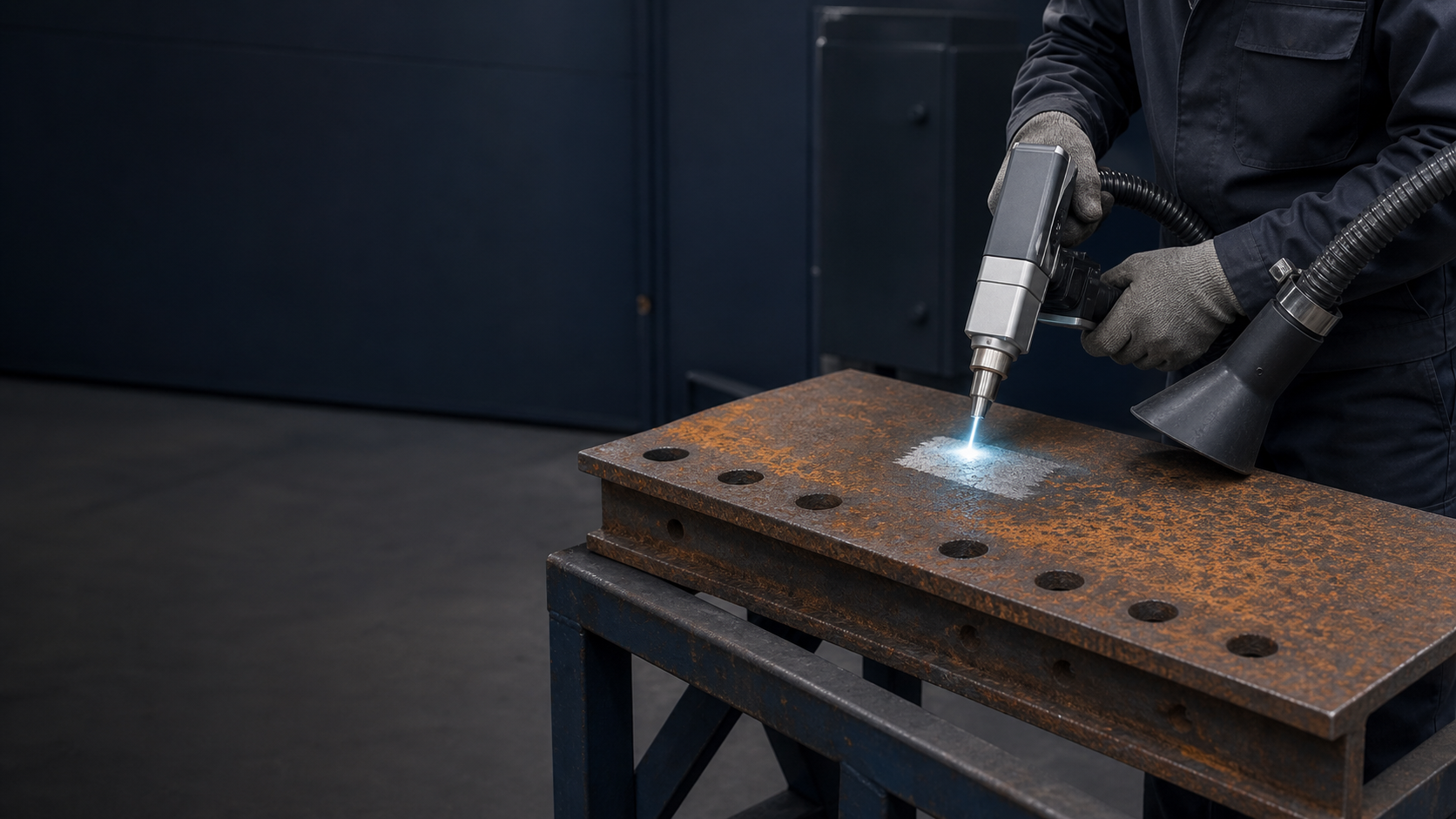
Reviewed August 13, 2026. Select a laser rust removal machine from a documented job and a representative sample, not from headline wattage or a short cleaning video. First define the corrosion layer, base metal, geometry and required next process; then test the proposed configuration, operating controls and quotation against that real requirement. Power alone is not a comparable specification without scan optics, extraction, safety controls, duty cycle and acceptance evidence.
1. Define the job before comparing machines
Rust is not a single condition. Light oxidation, pitting, mill scale, salts, oil and old coating layers can appear on the same part. Record the base metal and thickness, the layer stack, the affected area per shift, access limits and whether the work can be moved into a controlled cell.
Then define the result that must pass after cleaning. Will the area be coated, welded, bonded, inspected or simply stabilized for maintenance? A bright-looking surface is not automatically the profile, cleanliness level or chemistry required by the next operation.
This is the first buying decision. A localized maintenance repair may prioritize access and setup; a weld-preparation task may prioritize repeatability around edges; a coating job may require the coating owner's acceptance. If these jobs are all described only as “rust removal,” no supplier quotation can be compared fairly.
- Supply close and working-distance photos or video, with a scale reference.
- State the metal grade, thickness, part geometry and whether there are seams, edges, cavities or reflective nearby surfaces.
- Describe rust, scale, paint, oil, salts or other layers separately instead of calling everything “rust.”
- Specify the required next step and any customer-owned coating, welding or inspection acceptance criteria.
2. Test whether laser cleaning is the right first process
Laser cleaning is not automatically the best starting process because it is precise or visually impressive. Review the work area, corrosion severity, access and required surface condition first. Very large open areas, inaccessible cavities, heavy scale or a coating system that needs a defined preparation profile may point to a different process—or a combined workflow—after the customer validates the result.
The useful question is not whether a laser can remove rust from a coupon. It is whether the complete operation can meet the required quality, capacity and safety conditions without creating avoidable handling or finishing work. A credible supplier should identify the limits during sample-test planning, rather than treating every job as a laser fit.
| Review question | Laser cleaning may be worth testing when | Do not assume a laser is the first answer when |
|---|---|---|
| Work area and access | The job is localized, controlled or needs access around features. | The area is extremely large, open or difficult to contain and handle safely. |
| Required surface | The next process can be defined and checked on a representative sample. | A required profile, standard or coating result has not been established. |
| Workflow | The full handling, cleaning, inspection and extraction sequence can be evaluated. | Only a visually appealing cleaning clip is available as proof. |
| Decision evidence | The supplier will test the real material, worst relevant condition and acceptance criteria. | The proposal relies on generic wattage, speed or “no damage” claims. |
3. Build a pulsed vs continuous-wave test hypothesis
Pulsed and continuous-wave (CW) machines put energy into the job differently. A pulsed process is often a useful starting hypothesis where local control, detailed features, thin sections or heat sensitivity dominate. CW equipment may be a reasonable hypothesis for larger, robust steel areas where coverage and workflow matter. Neither label predicts the result by itself.
Published steel studies are a warning against buying by power alone: changes in fluence, overlap, speed and related process settings changed removal quality and surface response in the tested conditions. A reported best setting belongs to that study's material, rust and equipment—not to another buyer's job. Treat supplier throughput figures as proposals to test with stated material, layer, scan path and pass count.
Do not reduce the decision to “pulsed is gentle, CW is fast.” A robust structure can still have detailed edges, coatings or access limits; a sensitive part can still have a thin removable layer and a generous cycle time. The supplier should explain the starting hypothesis against the actual part, then prove it on representative material.
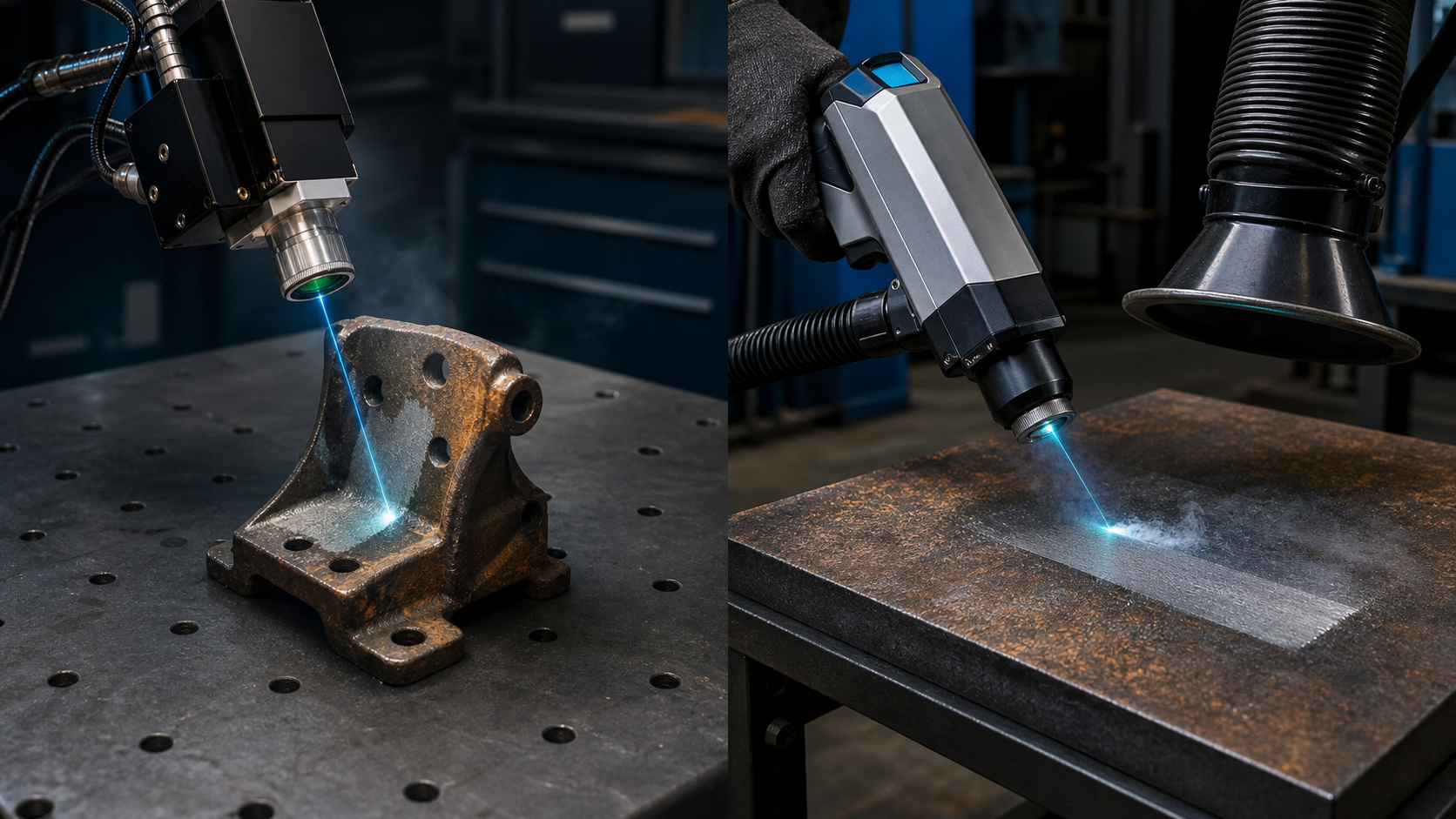
| Review point | Pulsed laser: typical starting fit | Continuous-wave laser: typical starting fit |
|---|---|---|
| Process control | Often considered where controlled local work, detail or heat sensitivity matter. | Often considered where robust material and broad coverage are the first requirement. |
| Heat-management priority | Review pulse settings, overlap and part response on thin or sensitive areas. | Review dwell, scan path and heat accumulation, especially near edges or thin sections. |
| Coverage workflow | Evaluate for targeted zones, features and varied geometry. | Evaluate for larger accessible areas where handling and coverage can be organized safely. |
| Best proof before purchase | Representative test at detailed features, edges and accepted surface condition. | Representative test at the required area, full workflow and downstream process condition. |
| Not a substitute for | A documented acceptance test and operator-safe recipe. | A documented acceptance test, extraction plan and site-safety review. |
Evidence: Experimental study: laser parameters, surface condition and corrosion resistance of 20 steel · Experimental study: laser cleaning quality optimization for Q390 steel rust
Explore continuous laser cleaning for larger-area process reviews4. Define the accepted surface, not only visual rust removal
Average power is only one input. The buyer should ask what adjustment range and documented settings are available for the relevant mode, scan pattern, spot size, focal distance, scan speed, overlap and number of passes. The useful question is whether an operator can repeat the validated recipe, not whether the front panel displays the largest number.
Set the pass/fail condition before the test. It may be a visual standard, a downstream coating check, a weld or bond test, a roughness or chemistry check, or a customer-defined inspection. If the next process is critical, arrange that follow-on test instead of accepting a before-and-after image as final proof.
Laser cleaning can remove corrosion products, but it cannot rebuild metal lost to pitting or restore a damaged profile. A cleaned surface may still need repair, machining, filling or finishing. That is a downstream decision, not evidence that the equipment failed.
| Record | Question to answer | Why it changes the purchase decision |
|---|---|---|
| Starting condition | What metal, layer stack, pitting and geometry were present? | Shows whether the sample represents the real job. |
| Validated recipe | What configuration, settings, optics, distance, passes and scan path were used? | Makes the demonstrated result auditable and repeatable. |
| Surface acceptance | What check passed after cleaning and who accepted it? | Prevents a visual result from being mistaken for downstream approval. |
| Limitations | What remained slow, inaccessible, pitted or heat-sensitive? | Defines the process boundary before purchase. |
Evidence: Experimental study: process variables change laser-cleaned steel surface response
Start a representative sample-testing conversation5. Turn the sample test into comparable evidence
The strongest pre-purchase evidence is a documented test on material that matches the job. Send an actual part or coupon with the same metal, corrosion or coating condition, geometry and acceptance requirement. Ask for before-and-after records, settings, measured work area, pass count, elapsed time, extraction arrangement and the resulting surface condition.
For a production decision, repeat the test on more than one representative area and include the downstream operation. The result should be a bounded process window and a pass/fail record—not a claim that one video proves universal speed, zero damage or compliance.
A useful supplier comparison uses the same sample question and acceptance record. This turns a sales demonstration into evidence that engineering, maintenance, procurement and the downstream-process owner can evaluate together.
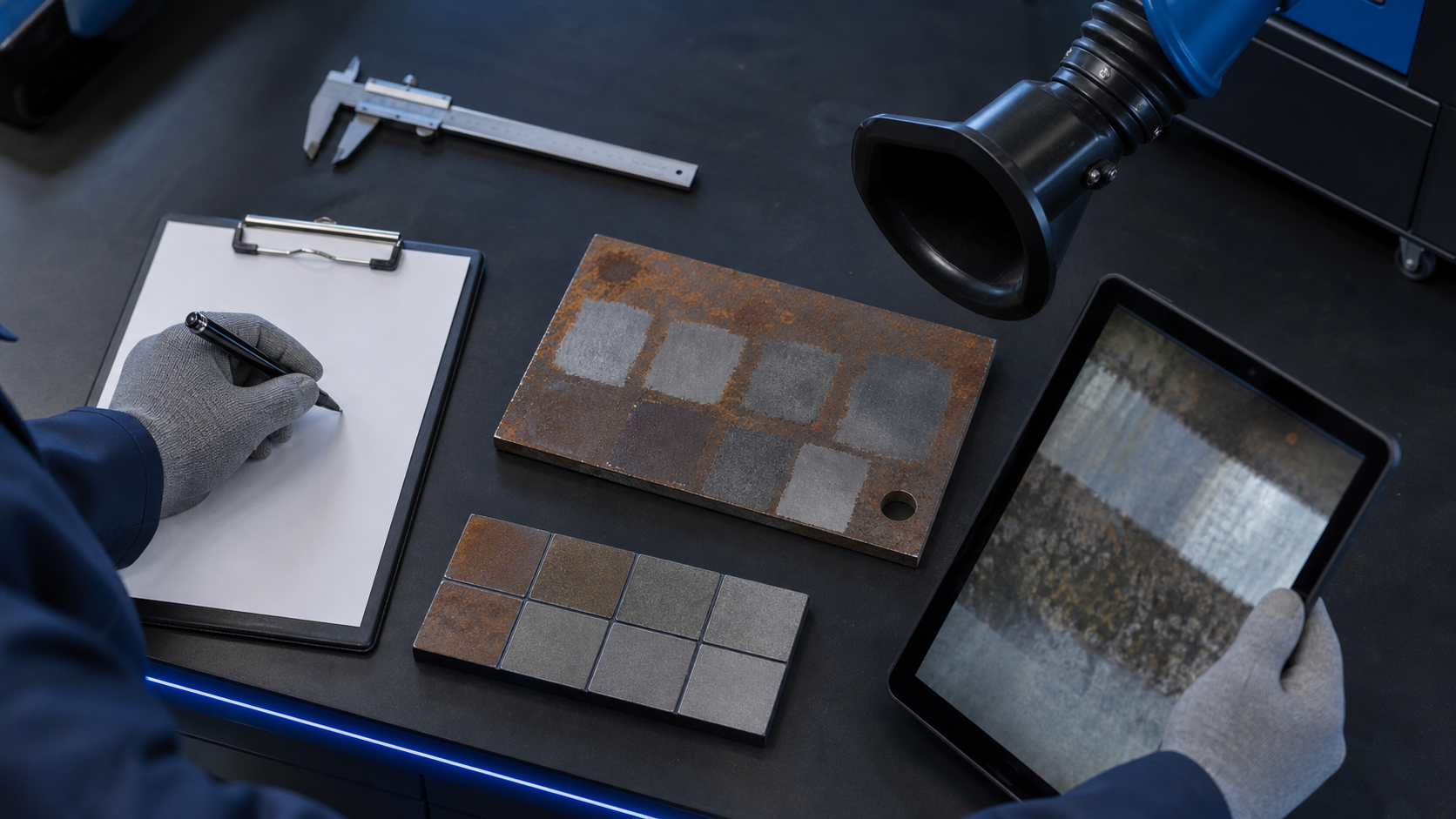
- What exact material, thickness and contaminant layer was tested?
- What configuration and settings were used, and can they be repeated on site?
- What is the measured area and elapsed cleaning time, including handling and repositioning?
- What surface checks and downstream tests passed, and who accepted them?
- What safety controls and extraction were in place during the test?
6. Price the controlled operating system, not only the laser source
An industrial laser-cleaning project is not just a laser source and a handpiece. OSHA identifies laser hazards as a workplace safety issue and its technical manual describes the need to control hazardous fumes and vapors produced by laser target interactions. Extraction must be designed around the real coating, corrosion, oil or residue—not assumed from a clean-steel demonstration.
Before ordering, map the controlled area or enclosure, beam containment and reflection risks, access control, interlocks, eyewear selected for the actual wavelength and operating mode, operator training, fire controls, electrical supply, cable reach, cooling needs and filter-change or disposal plan. Local law and the site safety team determine final controls.
Ask for the extraction, guarding, installation, training and site work as visible scope lines. A low machine price can be poor value when the equipment needed to operate safely is hidden outside the quotation.
Evidence: OSHA laser hazards overview · OSHA Technical Manual: laser safety and ventilation · OSHA: local exhaust ventilation principles
Prepare the configuration questions for a laser cleaning quote7. Compare quotations as complete, supportable systems
A machine that cleans a test coupon may still be wrong for the production workflow. Compare the real duty cycle, changeover, operator ergonomics, access equipment, motion system, guarding, extraction, electrical infrastructure, service reach and spare-parts plan. For repeatable work, also ask how the part is located, how the beam path is controlled and how a failed recipe or incomplete cycle is detected.
Request a written quotation that separates the confirmed configuration from options and excluded site work. It should identify the source type and power, handpiece or automation scope, cooling, extraction and guarding, electrical requirements, training, acceptance-test plan, documentation, warranty terms and service support. That makes supplier comparison meaningful without a price-per-watt shortcut.
| Quotation line | Confirm in writing | Why it matters |
|---|---|---|
| Validated configuration | Laser mode, source, optics, handpiece or automation scope and tested recipe. | Confirms what was actually proven on the sample. |
| Safe operating scope | Guarding, extraction, interlocks, training and site requirements. | Prevents essential controls becoming unpriced after delivery. |
| Acceptance plan | Sample, test record, downstream check, approver and limitations. | Turns the order into a verifiable project. |
| Support plan | Commissioning, documentation, service reach and spare-parts approach. | Shows whether the result can be supported after installation. |
FAQs
How much laser power is needed for rust removal?
There is no reliable universal wattage answer. Material, rust thickness, coatings, geometry, scan settings, required finish and production rate all affect the process. Start from a representative sample test with documented settings instead of selecting from power alone.
Is a pulsed or continuous laser better for rust removal?
Pulsed equipment is commonly considered first for controlled local or heat-sensitive work, while continuous-wave equipment may be considered for larger robust areas. Treat that as a test hypothesis; the correct choice depends on the validated process window and downstream requirement.
Is laser rust removal better than sandblasting?
Neither process is universally better. Laser cleaning can suit controlled, localized or precision work; blasting may remain more appropriate for some large, open or profile-dependent jobs. Compare the required surface condition, access, containment, throughput and follow-on process with a representative test.
Will laser cleaning remove corrosion pitting?
It can remove corrosion products, but it cannot replace metal lost to corrosion or restore a pitted surface. Repair, filling, machining or a separate finishing process may be required depending on the part’s acceptance criteria.
Does a laser rust removal machine need fume extraction?
The process can create airborne material from rust, coatings, oil and other residues. Extraction and other controls should be designed from the actual job hazard assessment and applicable local requirements; do not judge this from a clean demonstration alone.
What should I send for a laser rust removal machine quote?
Send photos or video, material and thickness, corrosion and coating details, area per shift, access constraints, electrical location, required next process and any acceptance standard. A representative sample is the best basis for a meaningful configuration and quote.