Automation safety
Automated Laser Cleaning Cell Safety: Verify Interlocks, Guarding and Vision Checks Before Commissioning
Before commissioning an automated laser cleaning cell, verify guarding, door interlocks, stop response and vision checks with recorded tests, not datasheet claims.
11 min readBy LaserLuma technical team
Published
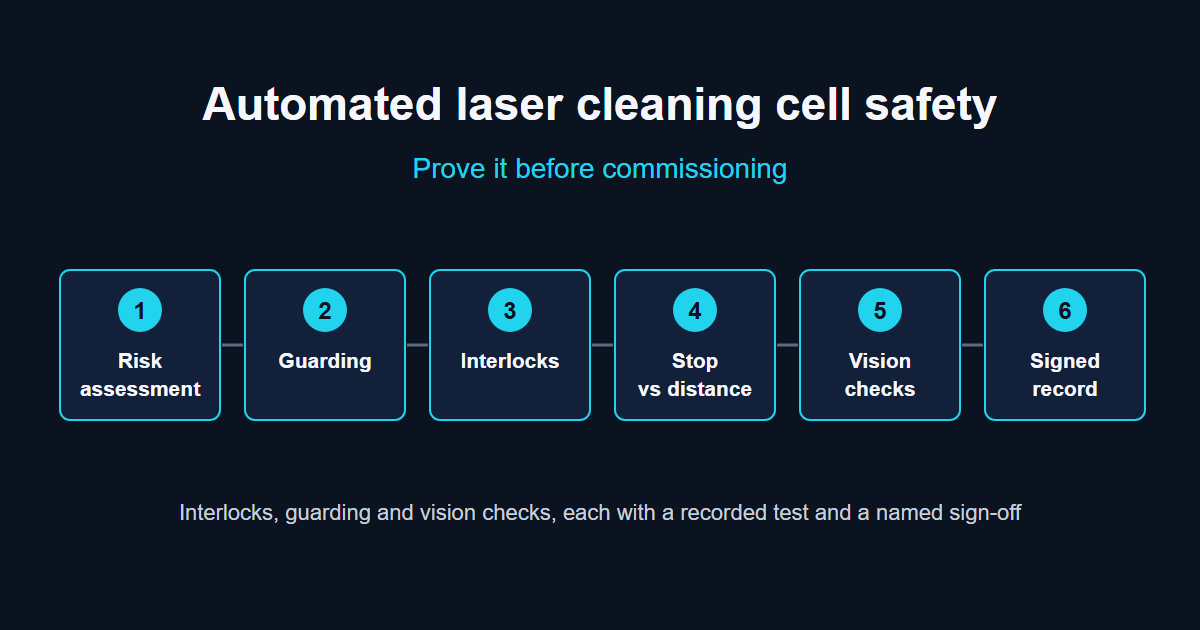
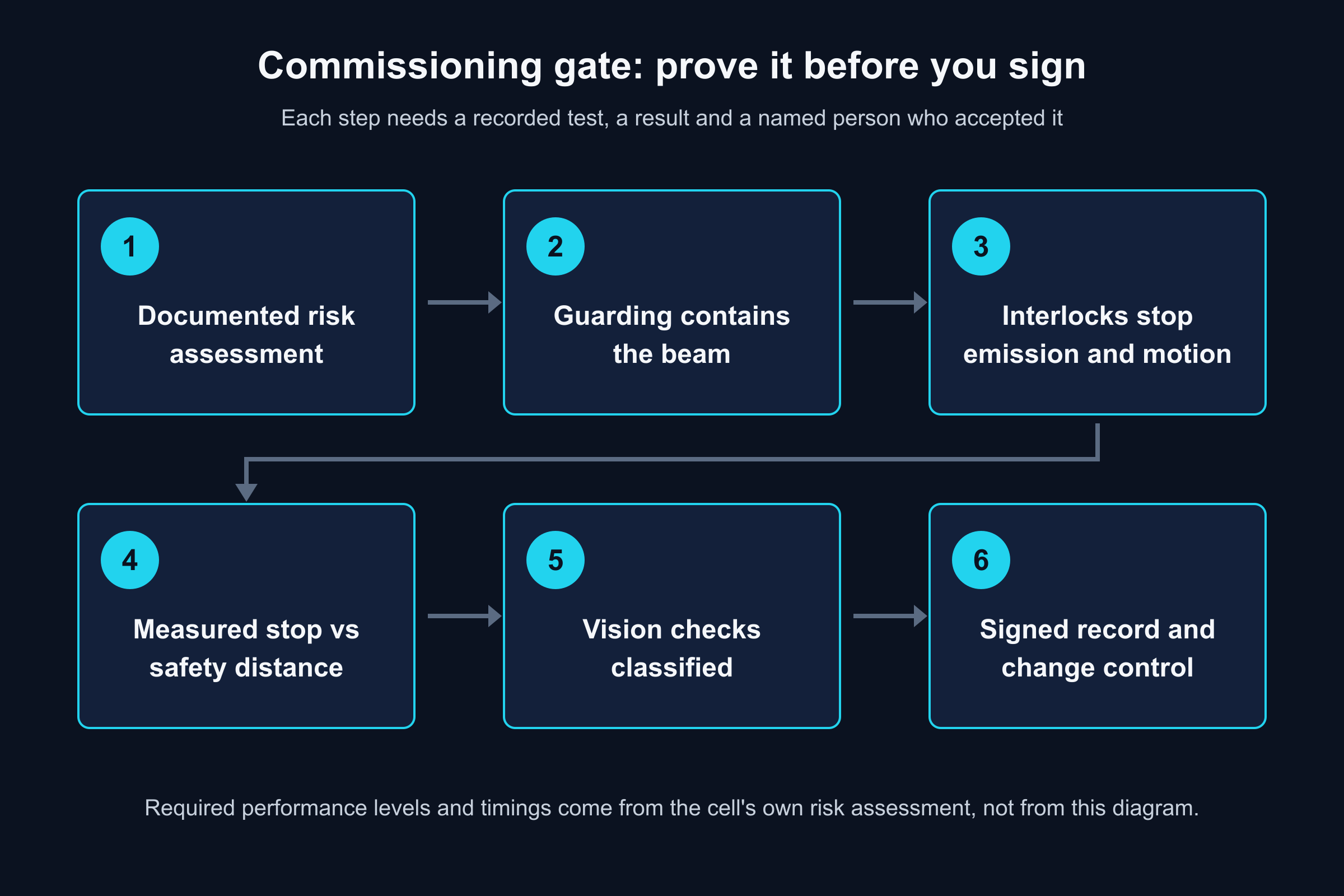
An automated laser cleaning cell is ready to commission only when its safety functions have been demonstrated in the installed configuration, not when the datasheet says "Class 1 enclosure with interlocked doors." Before sign-off, confirm four things with recorded tests: the guarding contains the beam at every opening, each door or panel interlock stops both laser emission and hazardous motion, the measured stop is fast enough for where the guard or sensor sits, and every vision check is classified as either a process check or a protective device. The required performance levels and timings come from your cell's own risk assessment, and passing these checks is not, by itself, approval to run the cell unattended.
Decide what "ready to commission" means before anyone signs
Commissioning is an acceptance decision, so agree on its content before the integrator arrives. OSHA's Technical Manual notes that ANSI/RIA R15.06-2012 calls for each robot application to have a risk assessment performed and documented prior to commissioning, and that site acceptance testing should be performed by the integrator and verified by the user. ISO 10218-2:2025 covers the integration, commissioning, operation and maintenance of industrial robot applications and robot cells. For a laser cleaning cell, that risk assessment has to cover two hazard families at once: laser radiation and reflections, and the robot, gantry or conveyor motion that presents the part.
In the United States, laser safety for a cell like this draws on more than one source. OSHA's laser guidance says citations are issued under the general duty clause or, in some cases, Subpart I, with employers expected to follow industry consensus standards such as ANSI Z136.1. That is why the useful question at commissioning is not "is it compliant?" but "which tests prove each safety function worked, in this configuration, and who accepted the result?"
Keep one boundary explicit from the start. A passed commissioning test shows that the tested functions worked in the tested setup. Whether the cell may later run without an operator present is a separate decision that depends on the site risk assessment and applicable rules, and OSHA's robot guidance itself notes that having a risk assessment on file is not sufficient on its own.
Evidence: OSHA Technical Manual: industrial robot systems · ISO 10218-2:2025
Review automated laser cleaning cell optionsCheck that the guarding contains the beam at every opening
OSHA's Technical Manual describes the most common Class I laser system as a high-power laser totally enclosed inside a protective enclosure, with interlocks or labels on every removable panel or access door. For a processing machine, IEC 60825-4:2022 specifies requirements for laser guards that enclose the process zone, including viewing windows, panels, laser curtains and walls, and describes how to assess and specify a guard's protective properties. In practice, "Class 1 cell" is a claim about the finished enclosure, so verify the enclosure you actually received rather than the one in the brochure.
Walk the cell with the integrator's drawings and look for every path light could take out of the process zone. Doors are obvious; conveyor ports, cable and hose pass-throughs, extraction ducts, panel seams and service hatches are easier to miss. Ask for the guard and window specification against the laser actually installed, and confirm that any opening needed for part flow is covered by the design rather than left for a later fix.
- Every door, hatch and removable panel is either interlocked or needs a tool to remove, as the design states.
- Viewing windows carry a specification for the installed laser's wavelength and power.
- Part-transfer openings, duct connections and cable pass-throughs are covered in the guard design.
- Warning labels and the emission indicator are visible from each access point.
- The guard assessment covers foreseeable faults, not only normal beam paths.
Evidence: OSHA Technical Manual: laser hazards · IEC 60825-4:2022 laser guards
Test every interlock as a function, not as a drawing
The laser source has its own federal baseline. Under 21 CFR 1040.10(f)(2), a laser product needs at least one safety interlock for each part of the protective housing designed to be removed or displaced during operation or maintenance where that would expose radiation above the applicable limit. Where a single interlock failure would allow that access, the product needs multiple interlocks or a way to prevent removal, and interlocks designed to be defeatable must visibly or audibly indicate that they are defeated. Class IIIb and IV laser systems also need a remote interlock connector and a removable key master control, plus an emission indicator.
OSHA's laser guidance adds that, under ANSI Z136, interlocks on embedded Class IIIB and IV lasers are to be fail-safe, which usually means dual, redundant, series-connected interlocks on each removable panel. A defeatable interlock needs a warning label, and the design should not let a panel be put back with the interlock still defeated. If the cell doors are wired into the laser's remote interlock connector, test that connection as part of the cell rather than assuming it.
A laser cleaning cell also moves parts or a cleaning head. OSHA's robot guidance lists interlocked barrier guards, fixed perimeter guards and presence-sensing devices among the safeguarding options, and ISO 14119:2024 sets principles for designing and selecting interlocking devices on guards, including measures that make foreseeable defeat harder. For commissioning, that means each door test should show two results: emission stops and hazardous motion stops.
- Open each interlocked door or panel during a controlled test and record that laser emission stops.
- Record that robot, gantry or conveyor motion also stops for the same door.
- Confirm that closing the door alone does not restart emission or motion without the designed reset.
- Confirm that any bypass or service mode is indicated, as the design states, and cannot be left active when the panel is refitted.
- Test the remote interlock and emergency stop circuits, not only the door switches.
Evidence: 21 CFR 1040.10 · ISO 14119:2024
Let the risk assessment set the performance level
Some vendor guides state a fixed interlock category as if it were the rule for every cell. ISO 13849-1:2023 instead provides a methodology and requirements for designing and integrating the safety-related parts of control systems that perform safety functions. The performance level a particular door interlock or stop function needs comes out of that cell's risk assessment and design, not from a general article or another supplier's datasheet.
For acceptance, ask the integrator for the safety function list: each function, the required performance level from the risk assessment, the achieved level claimed by the design, and how that claim was validated. If those three columns are missing or disagree, the discussion belongs before commissioning, with the site's safety professional involved. This article deliberately does not name a required level; confirm it with your risk assessment and integrator.
Evidence: ISO 13849-1:2023
Measure the stop, then compare it with the safety distance
A safeguard only works if the hazard has stopped before a person can reach it. ISO 13855:2024 sets requirements for positioning safeguards, including interlocking guards and the detection zones of electro-sensitive protective equipment, relative to how fast a body or body part can approach the hazard. OSHA's robot guidance says stopping-ability performance and the appropriateness of the application's safety distances should be checked, along with safety function settings.
So measure the stop rather than reading it off the design. One laser equipment supplier's published integration guide recommends cutting laser emission and robot motion within 50 ms of a fault and describes a door-open event that took 280 ms to register until a hardwired safety relay brought it to 38 ms. Those are one vendor's targets and anecdote, not a standard requirement, but they show why a measured value can differ from the assumed one. Record the measured stop for each safeguard, the method used, and the integrator's calculation showing that the guard or sensor position still works with that value.
Evidence: ISO 13855:2024 · Oceanplayer integration guide (vendor)
Classify each vision check before you rely on it
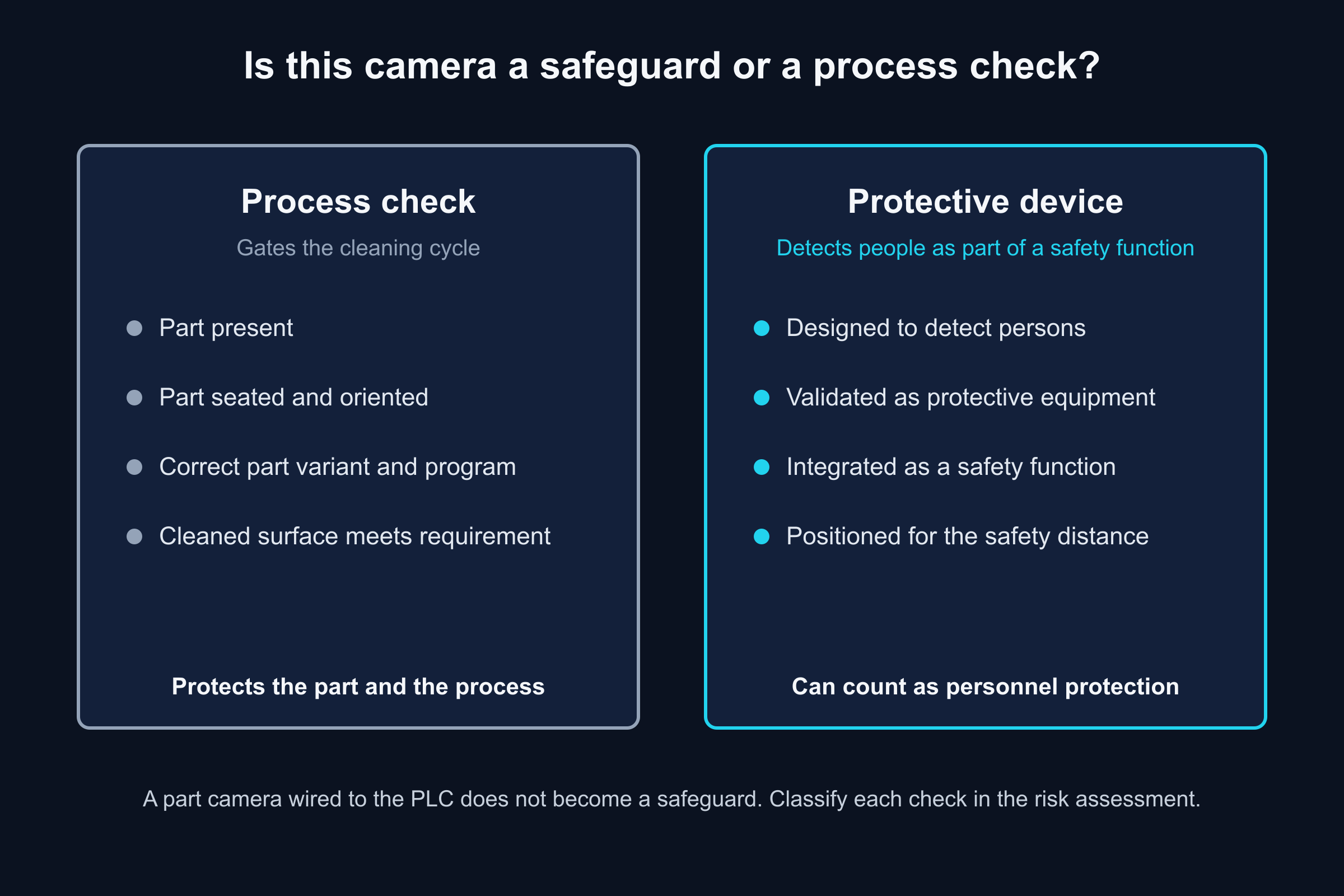
Many automated cleaning cells use cameras. Laser cleaning suppliers describe cameras that confirm a part is in the right position before cleaning starts, and cameras that check the quality of the cleaned surface. Those are useful process checks: they can stop the laser from firing on a missing, misplaced or wrong part, and they can reject a part that was not cleaned to the requirement.
They are not automatically safeguards. IEC TS 61496-4-3:2022 covers electro-sensitive protective equipment designed specifically to detect persons or parts of persons as part of a safety-related system, using vision-based protective devices. A part camera wired into the PLC does not become that kind of device. Unless a vision system is protective equipment designed and validated to detect people and integrated as a safety function, do not credit it in the risk assessment as personnel protection.
At commissioning, test the process checks as process checks: present a missing part, a misseated part and the wrong part variant, and confirm the cycle holds each time. Then confirm that personnel protection comes from the interlocked guards, protective devices and safety functions listed in the risk assessment.
| Check | What it protects | How to classify it | Evidence at commissioning |
|---|---|---|---|
| Door or panel interlock | People, from laser radiation and motion | Safety function | Door-open test: emission and motion stop; reset behavior recorded |
| Presence-sensing device (light curtain, scanner, vision-based protective device) | People entering a hazard zone | Safety function, if rated protective equipment | Detection and stop test; position checked against the safety distance |
| Part-position camera | The part and the process | Process check | Missing, misseated and wrong-part tests hold the cycle |
| Cleaned-surface inspection camera | Product quality | Process check | Reject test with a part that is not cleaned to the requirement |
| Emission indicator and key control | People, by warning and restricting operation | Laser product safety feature | Indicator visible from access points; key removal prevents operation |
Evidence: IEC TS 61496-4-3:2022 · Laserax battery cleaning machine (vendor)
Plan for teaching, service and changes, not only production
Production is not the only state the cell has to be safe in. OSHA's robot guidance notes that many hazards are introduced during the assembly, installation and testing of robot applications, and that robot speed during teaching should be reduced to 250 mm/s (10 in/s) or less. On the laser side, OSHA notes that many laser eye accidents occur during alignment and recommends a written procedure for recurring alignment tasks.
Service needs its own controls. 29 CFR 1910.147 covers servicing and maintenance where unexpected energization, start-up or release of stored energy could injure someone, and OSHA's robot guidance says hazardous energy should be controlled in line with that standard. OSHA's laser guidance allows a laser-controlled area to be set up temporarily during service, and it notes that ANSI Z136.1 requires a written standard operating procedure for Class IV lasers. Commission these procedures too: who may open the cell, how energy is isolated, and how the cell is proven safe before production restarts.
Changes undo commissioning evidence quietly. OSHA's robot guidance suggests checking the checksums of safety parameters as a quick way to see whether safety settings changed since the last inspection. Agree which changes trigger a re-test: new programs, recipe or laser changes, guard or sensor moves, and any safety parameter edit. Plume capture and exposure assessment are separate controls; the laser cleaning safety guide covers those.
Evidence: 29 CFR 1910.147 · OSHA Technical Manual: industrial robot systems · OSHA Technical Manual: laser hazards
Read the laser cleaning safety and fume extraction guideBuild the commissioning record and bring it to the cell discussion
A commissioning record is useful only if someone else can repeat it. For each safety check, record what was tested, the method, the result, the cell configuration it was tested in (program, laser settings, guard and sensor positions), and who accepted it. Repeat the affected tests after any change that touches guarding, interlocks, stop behavior, programs or safety parameters.
LaserLuma plans automated cells around part presentation, work zone, required cycle, safety, extraction and the validated cleaning process. Send those inputs, the planned acceptance tests and your site safety contact to start the cell discussion. The risk assessment, the safety design sign-off and approval to operate stay with the buyer, the integrator and qualified safety professionals.
- Documented risk assessment and the safety function list, with required and achieved performance levels.
- Guard walk-down results, including openings, windows and pass-throughs.
- Door, panel, remote interlock and emergency stop tests, each showing emission and motion stop.
- Measured stop values and the safety distance check for each safeguard.
- Vision check classification, with the process-check tests performed.
- Teaching, alignment, service and lockout procedures, and the re-test triggers.
- Names and roles of the people who accepted each item.
FAQs
What are OSHA's guidelines for laser safety in an automated cell?
OSHA's Technical Manual says laser citations are issued under the general duty clause or, in some cases, Subpart I, with employers expected to follow consensus standards such as ANSI Z136.1. It describes the common Class I arrangement as a high-power laser fully enclosed with interlocks or labels on every removable panel or door.
Does a Class 1 laser enclosure make the cell safe during maintenance?
Not by itself. The Class 1 rating describes the enclosed system in operation. When panels are opened for service, OSHA's guidance calls for controls such as a temporary laser-controlled area and a written procedure for Class IV lasers, and 29 CFR 1910.147 governs control of hazardous energy.
What performance level or category does a laser cell door interlock need?
There is no single answer. ISO 13849-1 provides the method, and the required level comes from your cell's risk assessment and design. Some suppliers publish fixed targets, such as a Category 4 chain, but those are their recommendations, not a general requirement; confirm the level with your integrator and safety professional.
Can a vision camera replace a door interlock or light curtain?
A process camera that checks part position or cleaning quality cannot. Only equipment designed and validated to detect people, such as a vision-based protective device within the scope of IEC TS 61496-4-3, and integrated as a safety function should be credited as personnel protection.
When do laser and robot cell accidents usually happen?
Often outside normal production. OSHA notes that many laser eye accidents occur during alignment, and that many robot hazards are introduced during assembly, installation and testing, which is why teaching, alignment and service procedures belong in the commissioning scope.