Automation
Robot vs Gantry vs Manual Laser Cleaning: How to Choose the Automation Level
Choose between manual staging, a gantry and a robot arm for laser cleaning by part geometry, mix, loading and envelope, then prove it on representative parts.
11 min readBy LaserLuma technical team
Published
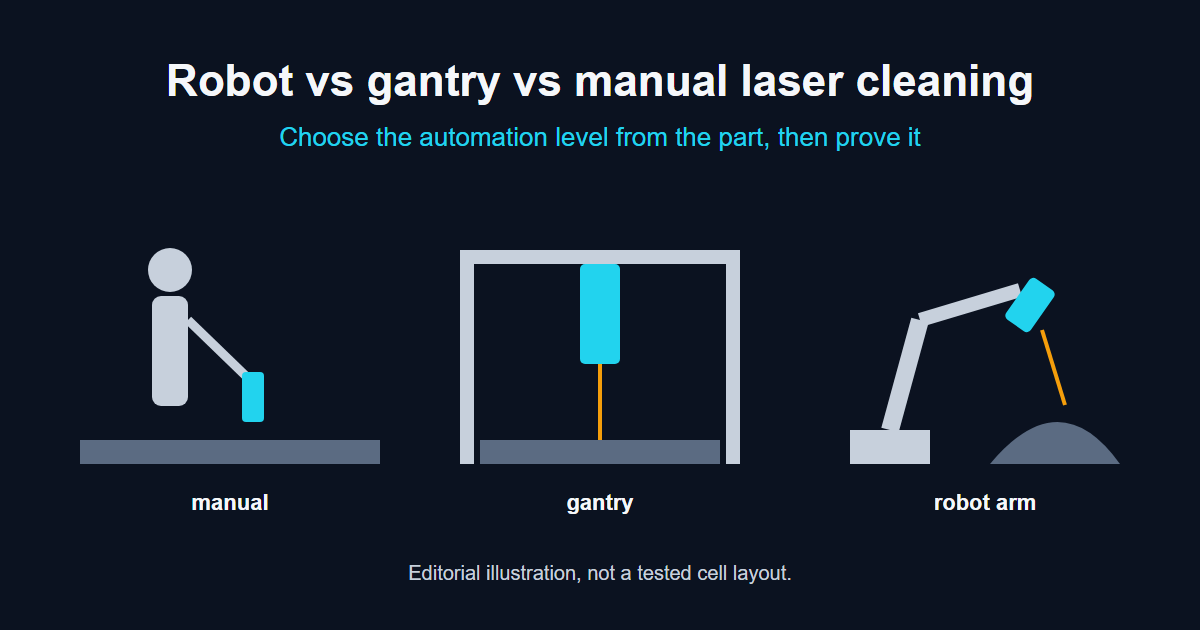
There is no single rule for whether a laser cleaning job belongs on a robot arm, a gantry or in an operator's hands, and IPG Photonics, which builds both robots and gantries, says neither is universally better. As a starting framework, the choice follows the part. Flat or single-face parts that repeat the same path usually point to a gantry or a fixed-head in-line system. Curved, multi-face or frequently changing parts at production volume point to a robot arm that can tilt the head to follow the surface. Low volumes, irregular jobs and on-site work on large structures often stay manual, or move to a manually loaded enclosed station. Decide how parts get in and out as a separate question, and confirm the choice on representative parts before you commit to a cell.
Three architectures that answer different questions
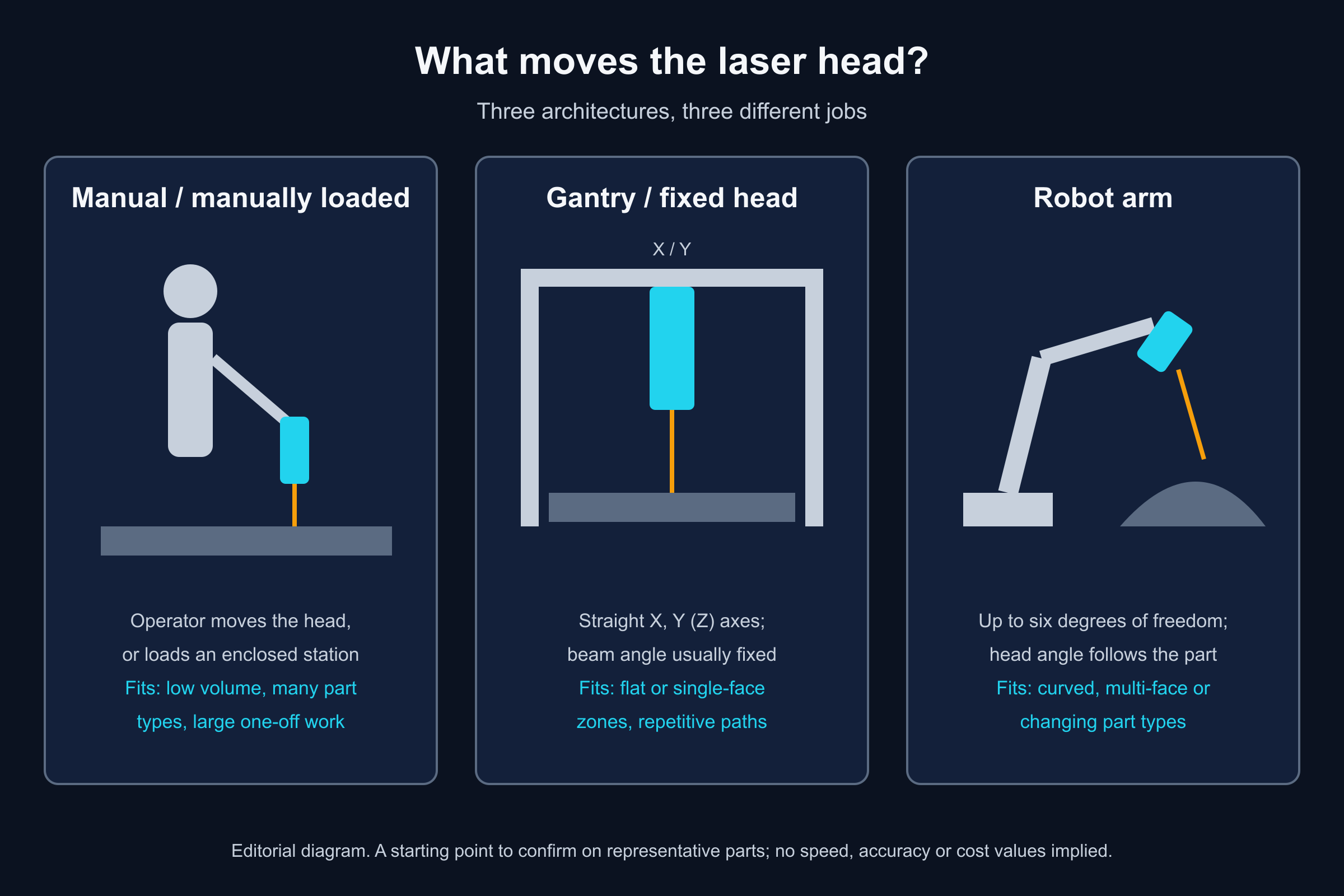
It helps to name what actually moves in each option. In manual cleaning, an operator moves a handheld head over the part, or loads parts into an enclosed station and starts a programmed cycle. Laserax, for example, describes manually operated workstations in which the operator loads the part and triggers the laser, and says its manual workstation suits jobs where the cycle time allows parts to be loaded and unloaded by hand.
A gantry moves the laser head, or the part, along straight axes. IPG Photonics, which builds both robotic and gantry laser systems, describes gantries as moving along linear X, Y and sometimes Z axes, with the beam angle usually fixed and typically perpendicular to the part. A related in-line format cleans parts as they pass on a conveyor. Laserax describes a conveyor machine that cleans parts stopped or moving on the line and can add a gantry over the conveyor to move the head. A robot arm is the third option. IPG describes it as a multi-axis arm that can move the processing head in up to six degrees of freedom, so the head can meet the surface at the angle the process needs.
IPG's summary is worth keeping in view: neither robotic nor gantry motion is universally better, and the right choice depends on the process, the required throughput, the allowable cost and the integration constraints. The same is true of manual work. Automation vendors such as Myrma argue that manual results depend on operator skill and precision, which affects repeatability, but that is an argument for checking repeatability on your parts, not proof that every job should be automated. Bogong, a vendor that sells both formats, describes handheld machines as suited to small-scale, irregular or on-site tasks such as maintenance, repair and on-site rust removal on large structures, and automated machines as suited to high-volume, repeatable production.
Evidence: IPG Photonics: Robotic vs. gantry laser systems · Laserax: Manual and automated laser cleaning machines · Laserax: Conveyor laser cleaning machine · Myrma: Automated vs manual laser cleaning · Bogong: Handheld vs automated laser cleaning machines
Start with the part, not the machine
In most cases, geometry narrows this decision faster than volume does. IPG says a robot arm can approach a part from virtually any angle, which suits complex three-dimensional shapes, features on several faces and cells that must handle varied part types or orientations. It describes gantry systems as generally best suited to flat surfaces, and notes that adding vertical or rotary stages never matches the range of motion of an arm.
For laser cleaning, the reason is the beam's relationship to the surface. A study published online in 2022 in Optics and Lasers in Engineering (vol. 160, 2023) built a robot-assisted laser cleaning system from a femtosecond laser, a six-axis arm and a laser profilometer that captured the part's shape. The system generated cleaning paths that kept the working distance and normal beam incidence fixed at each point, and it was tested on curved painted metal surfaces. That is a laboratory system, but it shows the job an arm does well: holding the process geometry constant on a surface that keeps changing direction. Laserax makes a related point about its own robot machine. It says angle control helps protect sensitive components from the beam and its reflections when the beam passes the edge of a part.
The flip side matters just as much. If the zones to clean sit on one face and the parts arrive in the same orientation, the extra axes of an arm add programming and cost without solving a real problem. Sort your part families by how many faces need cleaning, how curved those faces are, and how often the part type changes, before you look at any machine.
Evidence: IPG Photonics: Robotic vs. gantry laser systems · Rodriguez et al. 2022, robot-assisted laser ablation for 3D surfaces (Opt Lasers Eng) · Laserax: Robot laser cleaning machine
Precision, speed, programming and cost: what the suppliers say
The robot-versus-gantry comparisons cited here come from suppliers, so treat them as informed starting positions rather than test results. The table in this section summarizes IPG Photonics' comparison of the two for laser processing in general. It is not specific to cleaning, and it gives no numbers.
Speed is where comparisons most often mislead. IPG calls relative speed highly application dependent. A gantry may win on a flat part, while an arm may finish a multi-face part sooner simply because nobody has to turn the part over or build a second fixture. Throughput claims for automation work the same way. Loop Technology publishes cleanLASER rates for removing mould release residue in which the automated range is higher than the manual range for the same laser, for example 2 to 5 m² per hour manual against 4 to 10 m² per hour automated for one model. It also says rates vary with the part and the contaminant. Those figures belong to that equipment and that application. They are not a ratio you can apply to your parts.
| Factor | Gantry, per IPG | Robot arm, per IPG |
|---|---|---|
| Motion | Linear X, Y, sometimes Z; beam angle usually fixed | Up to six degrees of freedom; head angle follows the part |
| Precision and repeatability | Generally better, from rigid linear stages | More variation from joint deflection, backlash and calibration drift; vision or calibration helps at a cost |
| Speed | Typically faster on repetitive motion over flat parts | Can be faster overall on multi-face or 3D parts by avoiding repositioning |
| Programming | Generally easier, with G-code or CAD-to-path tools | More complex path planning from 3D models; simulation reduces risk |
| Cost | Generally more cost-effective for simple, precise flat-part work | Higher initial investment is possible; usually better value in flexible, multipurpose cells |
Evidence: IPG Photonics: Robotic vs. gantry laser systems · Loop Technology: Automated laser cleaning on a large scale
Decide how much of the loading to automate
The motion platform is only half of the automation question. The other half is how parts get into the work zone and out again, and this is often where manual labour stays, even in an automated cell. Published configurations show the range. Laserax describes a rotary workstation whose two-position table lets an operator load one part while another is being cleaned. For its robot cell, it lists door loading, where operators or robots place parts on a fixed table inside the cell (described as suited to shorter operations that fit the cycle time), conveyor loading, and a rotary table that loads and unloads parts while another part is cleaned. It also describes a compact door-type machine designed so an existing robot can load it.
That gives you intermediate steps between fully manual and fully automated. A manually loaded station with a programmed cleaning path removes the operator from the beam while keeping handling simple. A rotary table lets loading overlap with cleaning. A conveyor or a robot that loads the station removes manual handling altogether but ties the cell to the upstream and downstream flow. Each step changes what the fixtures, sensors and controls must handle.
In-line systems add one more question: how consistently parts arrive. Laserax states that the autofocus on its conveyor machine tolerates part position variation of plus or minus 70 mm. That figure describes that vendor's machine, not in-line systems in general, but it shows the kind of number to ask any supplier for when parts are not held in a fixed location. Measure how far your parts actually vary on the conveyor or rack before you assume a fixed path will reach every zone.

Evidence: Laserax: Manual and automated laser cleaning machines · Laserax: Robot laser cleaning machine · Laserax: Conveyor laser cleaning machine
Check what a quoted cycle time actually includesCheck the envelope and footprint against your largest part
Once geometry and loading point toward an architecture, check that it physically fits the largest part and the floor. A gantry carries its axes above the work. Macron Dynamics, a gantry supplier writing about general automation rather than laser cleaning, notes that gantries can be scaled to larger sizes in all three axes and suit work where little extra orientation is needed or where parts are staged before the gantry handles them. IPG adds the other side of the trade: a robot can sit beside a conveyor, inside a compact cell or serve several stations, while a gantry tends to need a larger dedicated footprint with mostly vertical access to the part, although gantries are often easier to implement as simple standalone operations.
For a robot, the limits are reach, working area and the load at the end of the arm. As an example of the values to compare, LaserLuma's catalogue lists its six-axis robot platform with a radius of motion of at least 933 mm, a maximum cleaning area of 800 x 675 mm and a maximum end load of at least 5 kg including the cleaning head, for 100 to 500 W air-cooled pulsed fiber lasers. Hold your largest part, its fixture and every zone to clean against numbers like these, and remember the head has to reach each zone at a usable angle, not just touch it.
Evidence: Macron Dynamics: Gantry systems overview · IPG Photonics: Robotic vs. gantry laser systems
Check the six-axis robot platform's catalogue envelopeWhat any automation level still has to prove
Choosing an architecture does not validate the cleaning process. The removal result, the substrate response and the acceptance criteria still have to be shown on representative parts, which is why suppliers such as IPG Photonics and Laserax invite sample parts for testing before a system is chosen. Extraction also moves with the architecture. On its robot machine, for example, Laserax mounts an extraction nozzle on the arm to capture dust and fumes at the source, so capture follows the head wherever it goes.
Safety scope does not shrink when the motion is simpler. OSHA's Technical Manual lists Cartesian robots, also called linear, XYZ or gantry-style robots, as a type of industrial robot. It says integrators must carry out hazard analyses and risk assessments for each robot application under the ANSI/RIA R15.06 framework, with compliance usually verified at site acceptance. ISO 10218-2:2025 sets safety requirements for industrial robot applications and robot cells from integration and commissioning through operation, maintenance and decommissioning. This guide does not replace that assessment.
Evidence: IPG Photonics: Robotic vs. gantry laser systems · Laserax: Conveyor laser cleaning machine · Laserax: Robot laser cleaning machine · OSHA Technical Manual: Industrial robot systems and safety · ISO 10218-2:2025, robot applications and robot cells
Place your application in one of the three
The checklist and the placement table in this section turn the criteria into a first placement. They are a framework drawn from the sources above, not a standard, and exceptions are normal. A large flat panel may still suit a robot if the same cell handles curved parts, and a small repetitive part may stay manual if volume is low.
- Count the faces and zones to clean on each part family, and note how curved they are.
- Estimate volume and the number of part variants per shift, and how often the part type changes.
- Decide how parts will arrive and leave, separately from what moves the laser head.
- Measure how much part position varies at the point of cleaning.
- Check the largest part, its fixture and each zone against the machine envelope.
- Plan a representative sample test and the risk assessment before fixing the cell layout.
| If your parts and production look like this | Start by evaluating | Check before you commit |
|---|---|---|
| Low volume, irregular jobs, or on-site work on large structures | Manual cleaning or a manually loaded enclosed station | Whether repeatability and operator exposure are acceptable for the job |
| Flat or single-face zones, same orientation, repetitive paths | Gantry or fixed-head in-line system | Part position variation, footprint and vertical access |
| Curved or multi-face zones, or frequent part changes in one cell | Robot arm | Reach, end load, angle at every zone and programming effort |
| Any of the above with a steady, high part flow | The same motion choice plus automated loading | How loading overlaps with cleaning and ties into upstream flow |
Evidence: IPG Photonics: Robotic vs. gantry laser systems · Laserax: Robot laser cleaning machine · Laserax: Manual and automated laser cleaning machines
What to send LaserLuma for a cell discussion
A useful first discussion needs the part and the production pattern, not a preferred machine. Send drawings or photos of each part family with the faces and zones to clean, the material and the contaminant or coating, and the downstream requirement. Add annual or shift volume, the number of variants and how often they change, how parts arrive and leave today, the largest part size and weight, the available floor space, and any robot, conveyor or enclosure you want to reuse.
LaserLuma's automated laser cleaning page covers robot, CNC and custom cells planned around part presentation, work zone, required cycle, safety, extraction and the validated cleaning process. The final configuration is confirmed after the application and quotation review, and no cycle, capacity or compliance outcome is implied before that work is done. Vendor statements in this guide are attributed to their sources and are not independent test data, and no universal throughput ratio, payback period, accuracy or price is stated for any architecture.
Discuss your cell requirementFAQs
Is a robot or a gantry better for laser cleaning?
Neither is better in general. Suppliers that build both, such as IPG Photonics, say the choice depends on the process, throughput, cost and integration. A robot arm suits curved, multi-face or frequently changing parts because it can tilt the head to follow the surface. A gantry suits flat, repetitive work, where it is typically faster and simpler to program.
When is manual laser cleaning still the right choice?
Manual cleaning, or a manually loaded enclosed station, often fits low volumes and jobs where the cycle time allows parts to be handled by hand. One vendor, Bogong, describes handheld machines as suited to irregular and on-site work, such as maintenance and rust removal on large structures. Automation vendors argue that manual results depend on operator skill, so check repeatability on your own parts before deciding either way.
Does a gantry laser cleaning system need the same safety assessment as a robot cell?
Plan for it. OSHA's Technical Manual lists gantry-style (Cartesian) robots as industrial robots and says integrators must carry out hazard analyses and risk assessments for each robot application. ISO 10218-2:2025 covers robot applications and cells through integration, commissioning, operation and maintenance.
Can a robot load parts into a laser cleaning station instead of moving the laser head?
Yes. Published configurations include door-type stations designed so that an existing robot can load parts, and robot cells with door, conveyor or rotary-table loading. Loading and head motion are separate decisions, so one robot can handle parts while a fixed head or a separate axis does the cleaning.