Process safety
Laser Cleaning Fume Extraction Airflow: Size Capture Velocity, Hood Distance and Duct Speed
Size laser cleaning fume extraction from the hood out: pick a capture velocity band, fix the capture distance, set duct speed, then prove capture at the work.
12 min readBy LaserLuma technical team
Published
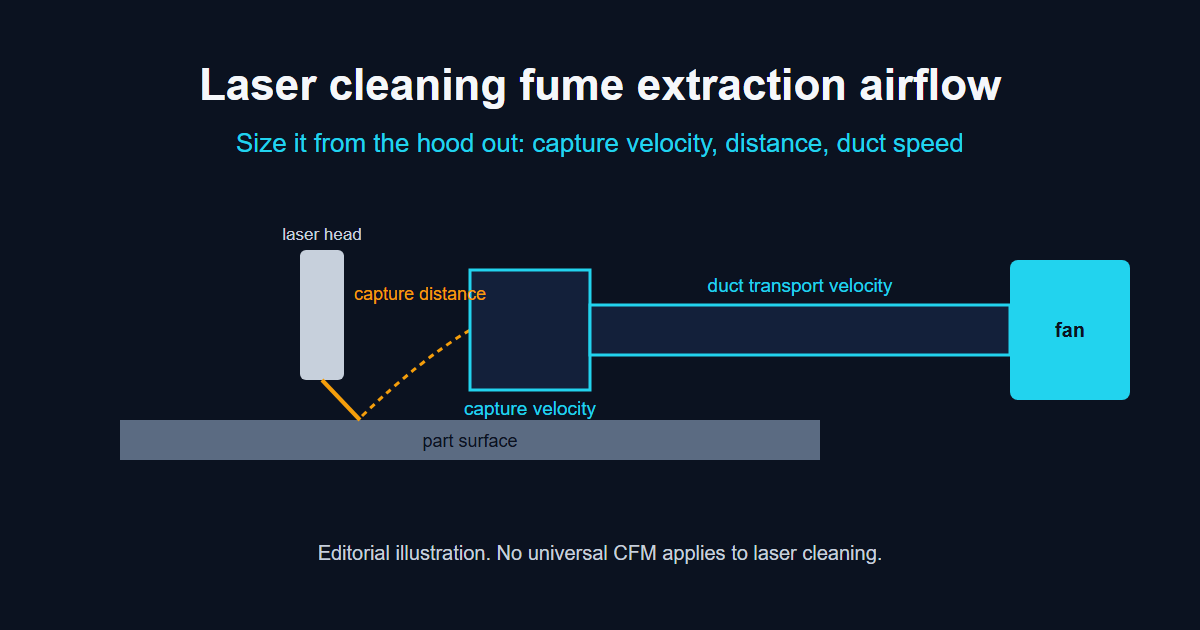
You cannot size laser cleaning fume extraction from an extractor's CFM rating. Airflow is the result of three decisions made at the hood. The first is how fast air must move at the point where the plume leaves the surface (capture velocity). The second is how far that point sits from the hood, and the airflow needed rises roughly with the square of that distance. The third is how fast the air must travel in the duct so fume and removed dust do not settle. Published guidance gives ranges and rules of thumb, not a laser-cleaning number: air speed in front of a simple capturing hood falls to about one-tenth of its face velocity one hood diameter out, and HSE recommends about 10 m/s in ducts for fume and smoke and more for dust. Choose the hood and distance first, let the extraction designer turn them into airflow, then prove capture with the process running and keep that result as your benchmark.
Why an extractor's CFM rating is not the sizing answer
Laser cleaning puts material into the air. LaserLuma's safety and fume extraction guide notes that the plume's composition depends on the removed layer, the base material and the process, so the real contaminant has to be assessed rather than assumed. Research supports taking the particle side seriously: a 2024 study in Environmental Research looked at laser cleaning of corroded 304L stainless steel, investigating the airborne nanoparticles the process released, how laser parameters changed their size and amount, and whether HEPA filters could capture them. OSHA's Technical Manual sets the objective for laser work in general: adequate ventilation should reduce fumes and vapors from laser target interactions to below applicable limits such as ACGIH TLVs or OSHA PELs.
Meeting that objective comes down to capture at the source. OSHA's Technical Manual calls it a common misconception that hoods draw air from a significant distance, and says hoods must be close to the source to be effective. CCOHS puts numbers on it for a simple capturing hood: the required airflow rises with the square of the distance from the source, so moving a hood from two inches to four inches away takes four times the airflow for the same capture. An extractor rated at a few hundred CFM can capture well in one position and do almost nothing a hand's width further away. The rating is a property of the fan and filter. Capture is a property of the whole arrangement, which is why the sizing below starts at the hood and works back to the fan.
This article covers the airflow sizing only. Beam control, filter chemistry, fire provisions and exposure assessment belong to the wider safety plan.
Evidence: Park & Park 2024, airborne nanoparticles from laser cleaning (Environ Res) · OSHA Technical Manual: Laser Hazards · OSHA Technical Manual: Ventilation Investigation · CCOHS: Industrial ventilation, hoods
Start with the laser cleaning safety and fume extraction control planStep 1: Describe the plume before you choose a velocity
Capture velocity is the starting number, and it only means something with a distance attached. HSE's local exhaust ventilation guide, HSG258, defines it as the air velocity needed at the contaminant source to overcome the movement of the contaminant cloud and draw it into the hood, and notes that it is meaningful only with a defined distance between source and hood. HSE groups sources by how much energy the cloud is released with, and says its ranges are based on success through experience: the designer and supplier should check them and, where necessary, build prototypes.
Laser cleaning is not one of HSG258's listed examples, so do not borrow the lowest band because the process looks clean. Watch how the plume and debris actually leave the surface under your recipe. Note whether a faint smoke drifts in still air or particles are thrown off the surface, and which way the head moves them. Then place the job in a band with your extraction designer. CCOHS gives a useful sense of scale: about 0.5 m/s (100 fpm) is typical where a contaminant is released into practically still air, and 5 to 10 times more may be needed where contaminants are released at high speed into moving room air. HSE adds that the lower end of each range suits low-toxicity materials, intermittent use, larger hoods and no draughts, and the upper end suits highly toxic materials, continuous use, smaller hoods and draughts.
| How the contaminant cloud is released | HSE example processes | Capture velocity range | Approx. fpm |
|---|---|---|---|
| Into still air with little or no energy | Evaporation, mist from electroplating tanks | 0.25 to 0.5 m/s | 50 to 100 |
| Into fairly still air with low energy | Welding, soldering, liquid transfer | 0.5 to 1.0 m/s | 100 to 200 |
| Into moving air with moderate energy | Crushing, spraying | 1.0 to 2.5 m/s | 200 to 500 |
| Into turbulent air with high energy (hard to control with capturing hoods) | Cutting, abrasive blasting, grinding | 2.5 to more than 10 m/s | 500 to 2,000+ |
Evidence: HSE HSG258: Controlling airborne contaminants at work (LEV) · CCOHS: Industrial ventilation, hoods
Step 2: Enclose first, then decide how open the hood can be
The cheapest airflow is the airflow you do not need. All three government sources agree on this. HSG258 states that enclosures are always more effective than capturing or receiving hoods, CCOHS says the enclosing hood is preferred whenever possible, and OSHA's Technical Manual says the operation should be enclosed as much as possible to minimize airflow requirements. For a fixed laser cleaning station or an automated cell, ask early whether the laser enclosure can also serve as the extraction enclosure, instead of relying on a nozzle held beside the work.
When the part or the access needs mean the work cannot be fully enclosed, a partial enclosure is the next step. HSG258's design principles for partial enclosures call for a face velocity high enough to contain the contaminant cloud, a minimum of 0.4 m/s unless a lower face velocity is shown to work. If the plume leaves the surface in a strong, predictable direction, HSE describes a receiving hood placed in that path. It has to be large enough and close enough to intercept the cloud. Only where neither is practical should the design fall back to an open capturing hood or extraction arm, because that is where the distance rules in the next step bite hardest.
Evidence: HSE HSG258: Controlling airborne contaminants at work (LEV) · CCOHS: Industrial ventilation, hoods · OSHA Technical Manual: Ventilation Investigation
Step 3: Fix the capture distance and mark it
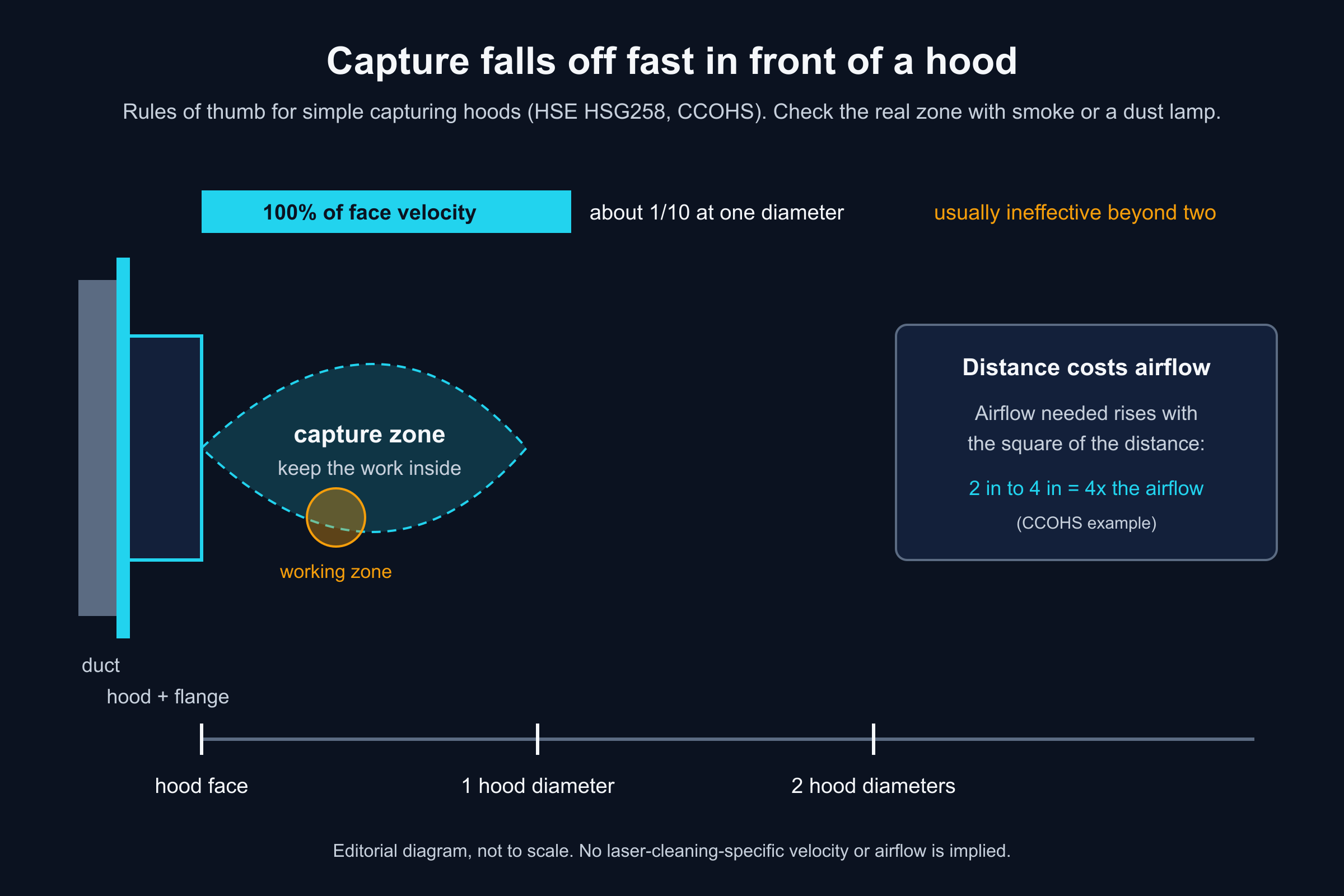
For an open capturing hood, distance sets the airflow more than anything else. HSG258 gives the rule of thumb that air velocity falls to about one-tenth of the face velocity one hood diameter out from the hood face, and that capturing hoods are usually only effective when the source is within two hood diameters. OSHA's Technical Manual puts it in duct terms. It recommends keeping the source no more than 1.5 duct diameters from a simple capture hood, which is about 9 inches for a 6-inch duct, with a capture velocity of at least 50 fpm. It also gives an example in which a 3,000 fpm duct velocity produces about 300 fpm one duct diameter out and only about 30 fpm at two diameters.
A published airflow table shows how fast the numbers grow. OSHA's welding rule, 29 CFR 1910.252(c)(3)(i), requires movable welding hoods to keep 100 feet per minute toward the hood in the welding zone, and tabulates the airflow for a 3-inch flanged opening at different distances. It is a welding requirement, not a laser cleaning requirement, but the pattern is the same one your designer will be working with. The table follows the figure below.
Going from the closest to the farthest row in the welding table below quadruples the airflow for the same capture velocity. That is why the capture distance has to be a design decision, recorded and marked, not wherever the hose happens to be clipped. HSG258 warns that the capture zone is almost always smaller than users expect. It recommends marking the zone on the workstation, or marking the hood with its maximum capture distance. For work that moves along a part, which describes most laser cleaning passes, it says an adjustable hood or workstation should keep the working zone inside the capture zone, and another type of hood should be used where that is impractical. Flanges help. HSE notes they cut the air drawn from behind the hood, give a larger capture zone with a longer reach, and make the hood more efficient.
| Distance from arc or torch | Minimum airflow | Duct diameter in the rule |
|---|---|---|
| 4 to 6 inches | 150 cfm | 3 in |
| 6 to 8 inches | 275 cfm | 3.5 in |
| 8 to 10 inches | 425 cfm | 4.5 in |
| 10 to 12 inches | 600 cfm | 5.5 in |
Evidence: HSE HSG258: Controlling airborne contaminants at work (LEV) · OSHA Technical Manual: Ventilation Investigation · 29 CFR 1910.252 (welding, cutting and brazing)
Step 4: Protect the capture zone from drafts and the operator
A correctly sized hood can still fail in a real shop. OSHA's Technical Manual says strong cross-drafts can easily reduce a hood's effectiveness by 75%. When hood airflow checks out but control is still poor, it points to cross-drafts from process air, worker-cooling fans, air-supply systems, and open doors and windows. HSG258 makes the same point about the capture zone itself: draughts can severely change its size and shape, and powerful draughts virtually destroy it. Walk the area with the doors, fans and make-up air as they will be in production, and treat a nearby dock door or pedestal fan as a design input, not a detail.
The operator's position matters too. OSHA's Technical Manual says the hood should be placed so contaminants are not drawn through the worker's breathing zone, which HSG258 defines as roughly the space within 300 mm of the nose or mouth. When the operator works close to the spot, as in handheld cleaning, check that the airflow pulls the plume away from the face, not across it.
Evidence: OSHA Technical Manual: Ventilation Investigation · HSE HSG258: Controlling airborne contaminants at work (LEV)
Step 5: Size the duct for transport velocity, not just volume
Once the hood airflow is known, the duct has a second job: keep what the hood caught moving. OSHA's Technical Manual says air in ducts typically moves at 2,000 to 6,000 fpm and defines minimum transport velocity as the velocity that carries particles with little settling. It also notes that plugged ducts occur when transport velocity is inadequate. HSG258 explains the consequence: settled particles narrow the duct, increase resistance and reduce airflow, and can cause blockage and a fire risk from flammable material. In a multi-branch system, HSE says the design has to deliver the required velocity from the hood furthest from the fan with the maximum number of hoods open.
Laser cleaning can put both fume and solid debris, such as rust, scale or paint fragments, into the same duct, so ask the designer which row of HSE's table governs your job.
The arithmetic linking duct velocity to airflow is simple, which makes it easy to check a proposal. Airflow equals duct velocity times the duct's cross-sectional area. As an illustration only, a 150 mm round duct run at 10 m/s carries about 0.18 m³/s, roughly 640 m³/h or 375 cfm, and the same duct at 20 m/s needs about twice that. If a quotation pairs a large duct with a small fan, or the hood airflow from Step 3 is well below what the duct needs to keep its velocity, one of the two numbers is wrong.
| Type of contaminant | Indicative minimum duct velocity |
|---|---|
| Gases and non-condensing vapours | 5 m/s |
| Condensing vapours, fume and smoke | 10 m/s |
| Low or medium density dusts, fine dusts and mists | 15 m/s |
| Process dust, such as grinding dust | around 20 m/s |
| Large, aggregating or damp particles | around 25 m/s |
Evidence: OSHA Technical Manual: Ventilation Investigation · HSE HSG258: Controlling airborne contaminants at work (LEV)
Step 6: Leave fan and filter margin for real operating conditions
The fan must deliver the design airflow against the resistance of the whole system, including filters as they load, not just when everything is new. OSHA's Technical Manual lists what fan selection needs: the air volume, the fan static pressure, the type and concentration of contaminants, and any noise limits. Its troubleshooting list reads like a checklist of what erodes margin in practice: clogged collectors or air cleaners, closed dampers, lack of make-up air, and even a fan wired to run backward, which delivers only 30-50% of its rated flow.
Filter choice follows the contaminant, not the airflow. As LaserLuma's safety guide notes, particle filtration and gas or vapour control are different functions, and returning filtered air to the room is not acceptable just because the unit has a filter. Ask the supplier to state the airflow at the hood with clean filters and at the filter change point, so you know the capture you are buying at both ends of the filter's life.
Step 7: Prove capture at the work position and keep a benchmark
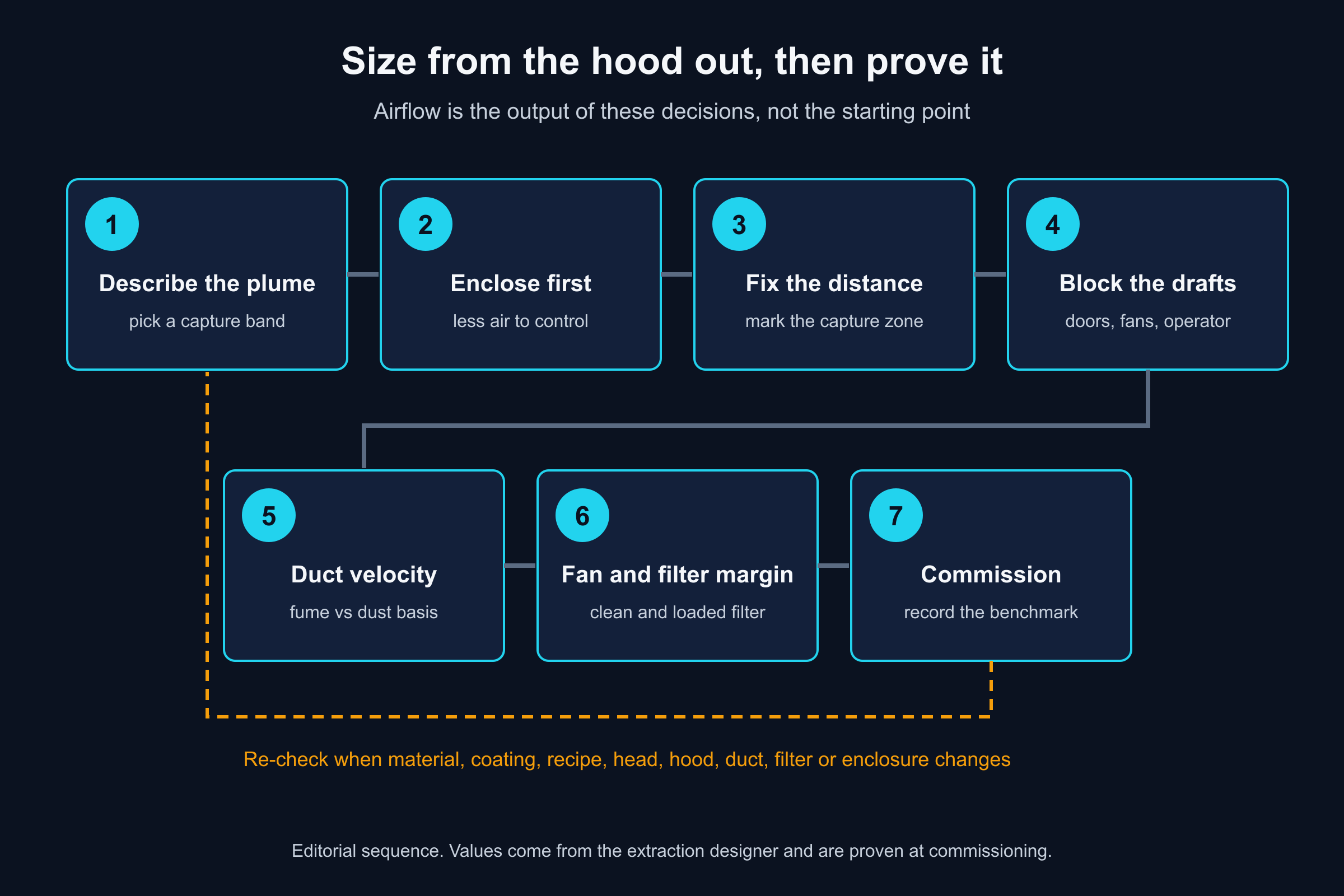
Sizing is a prediction; commissioning is the proof. HSG258 describes commissioning as proving that the system gives adequate control, in four stages. The first verifies the installation. The second shows the system meets its specified technical performance. The third demonstrates control effectiveness, meaning the plume is actually captured. The fourth reports the results as benchmarks for later maintenance, examination and testing. For laser cleaning, run the effectiveness check with the real recipe, part and head motion. HSE lists smoke tracers and dust lamps for seeing the cloud, and an anemometer for measuring velocity.
The benchmark is what makes later checks meaningful. OSHA's Technical Manual says hood static pressure is measured about 4-6 duct diameters downstream in a straight section of the hood duct, and lists a daily look at hoods, ducts and hood static pressure among good maintenance practice. HSG258 says the simplest way to show an operator that a hood is working is an airflow indicator, usually a manometer, that shows clearly when the airflow is adequate. Evidence from welding shows why this matters. A 2012 review of welding-fume local exhaust ventilation found field studies suggesting 40-50% or more exposure reduction compared with natural ventilation, but only with correct hood positioning and adequate exhaust flow.
- Record the hood type, position and marked capture distance for each work position.
- Record face or capture velocity at defined points, and hood static pressure at the marked tap.
- Record the smoke or dust-lamp observation with the real recipe, part and head motion.
- Record the duct velocity basis (fume or dust) and the fan operating point.
- Record the airflow indicator's acceptable range and who checks it.
- Re-check when the material, coating, recipe, head, hood, duct, filter, enclosure or cycle changes.
Evidence: HSE HSG258: Controlling airborne contaminants at work (LEV) · OSHA Technical Manual: Ventilation Investigation · Flynn & Susi 2012, LEV for welding fumes (Ann Occup Hyg, CDC Stacks)
What to send LaserLuma before a sample test
A representative sample test is where the plume, the recipe and the extraction arrangement can be observed together. Bring the base material and every removable layer with any coating history. Say whether the head is handheld, fixed or robot-guided and how it moves over the part. Include the existing enclosure, hood type, hood distance, duct size and extractor data, plus notes on room drafts, doors and make-up air near the work, and photos or video of the area.
LaserLuma can use these inputs to plan a representative sample test and an equipment discussion. Extraction design, exposure control, regulatory compliance and operating approval remain site-specific responsibilities for the buyer and qualified professionals.
Plan a sample test with your extraction arrangement recordedFAQs
What is the recommended CFM for laser cleaning fume extraction?
There is no single figure. Airflow follows from the capture velocity you need at the plume and the distance from the hood. Needed airflow rises roughly with the square of that distance, and air speed falls to about one-tenth of face velocity one hood diameter out. Laser cleaning is not in HSE's capture velocity table, so place your job in a band by observing its plume and let the designer calculate the airflow.
How close should the extraction hood be to the laser cleaning spot?
As close as the work allows. OSHA's Technical Manual recommends no more than 1.5 duct diameters from a simple capture hood. HSE says capturing hoods are usually only effective within two hood diameters, and that the capture zone should be marked so operators can keep the work inside it.
What capture velocity should a laser cleaning hood provide?
HSE's published ranges run from 0.25-0.5 m/s for clouds released into still air up to 2.5 m/s and beyond for high-energy releases such as cutting or grinding. HSE says the values come from experience and should be checked. Since laser cleaning is not listed, the band is a judgement to make from the observed plume and confirm at commissioning.
Is a portable fume extractor enough for laser cleaning?
Only if its hood can keep the moving work inside its capture zone, and that is shown with the process running. HSE warns that the capture zone is almost always smaller than users expect, and recommends commissioning that demonstrates control effectiveness and records a benchmark.
What duct velocity keeps laser cleaning dust from settling?
HSE recommends about 10 m/s for fume and smoke, 15 m/s for fine dusts and around 20 m/s for process dust such as grinding dust. If your job produces solid debris as well as fume, the dust rows usually govern. Too low a velocity lets particles settle, which reduces airflow and can block the duct.