Compliance documents
Laser Cleaning Machine Certification Documents: What to Request and How to Check Them
Request the FDA accession number, label photos, manual and EU declaration for a laser cleaning machine, and check each against the rule text before import.
13 min readBy LaserLuma technical team
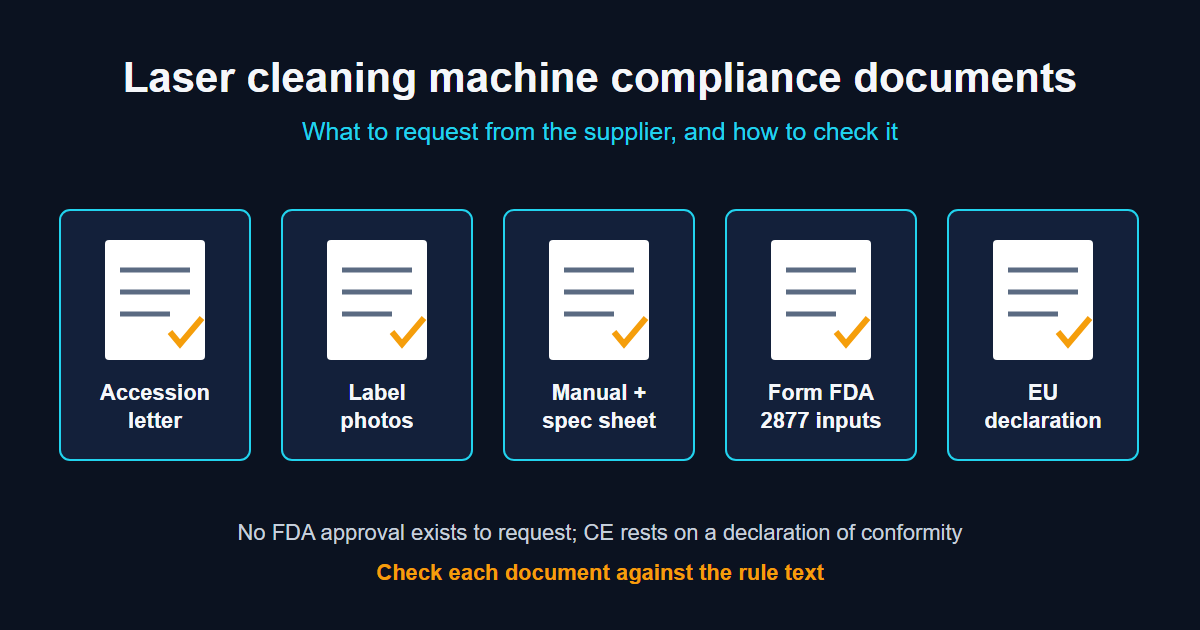
There is no FDA certificate to request for a laser cleaning machine. In the US, the manufacturer certifies its own laser product, reports it to FDA's Center for Devices and Radiological Health (CDRH), and labels it, and FDA does not approve the product or the certification. What you can request is evidence: the accession number and acknowledgement letter for the product report, photos of the certification, identification and warning labels, the user manual and spec sheet, and the information your importer needs for Form FDA 2877. If the same machine is also placed on the EU market, add the declaration of conformity and confirmation that the technical file exists. This guide shows how to check each document against the rule text. It is not legal advice, and the final compliance position belongs to your importer of record, customs broker, notified body or counsel.
Start by dropping the idea of an FDA certificate
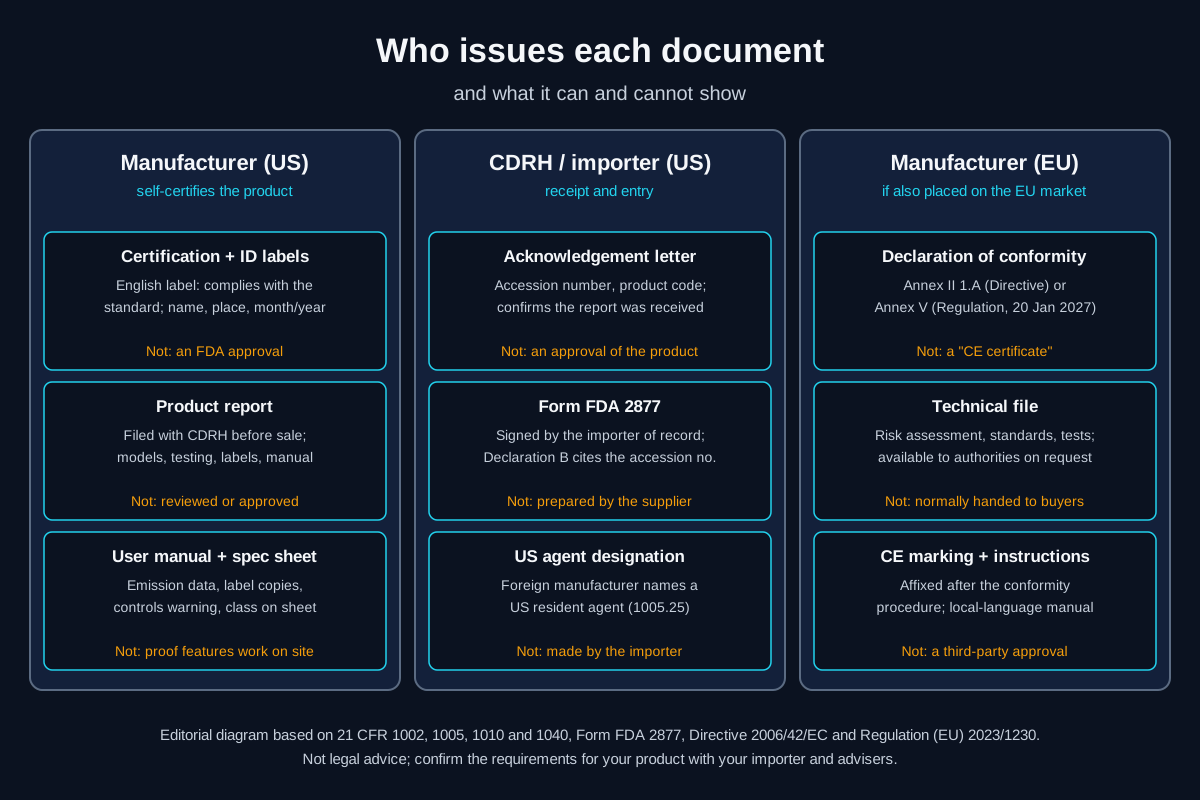
Supplier pages often promise "FDA certification" or "FDA approval", and a buyer who asks for the certificate usually receives a PDF that proves less than it seems to. FDA's own answers are direct. Certification means the manufacturer states that its product complies with the applicable FDA performance standard, based on its own quality control and testing program, and it does not indicate FDA approval. FDA does not approve that certification either.
The accession number is also not an approval. FDA says an accession number only means CDRH's Document Control Center received a report and entered some manufacturer and product information into its database, and that CDRH has no authority to approve the radiation safety of an electronic product. FDA also says it does not recognize regulatory approvals from other countries or other organizations, so a foreign test certificate does not replace the US requirements.
The CE side works the same way. Under Directive 2006/42/EC, the manufacturer or its authorized representative must meet the essential health and safety requirements, keep the technical file available, provide instructions, complete the conformity assessment, draw up the EC declaration of conformity and then affix the CE marking. The European Commission warns that "voluntary certificates" from bodies not acting as notified bodies are not a recognized means of proving compliance, that only notified bodies may issue certificates within the area they are notified for, and that it is not acceptable for a certificate to bear a CE marking. When a supplier offers a "CE certificate", ask for the declaration of conformity instead.
Evidence: FDA: Getting a radiation-emitting product to market (FAQ) · European Commission: Machinery · Directive 2006/42/EC (EUR-Lex)
Which US rules a laser cleaning machine answers to
FDA's Laser Notice No. 56 summarizes the baseline. Laser products introduced into US commerce, including imports, must comply with 21 CFR 1040.10 and 1040.11 as applicable, be certified and identified under 21 CFR 1010.2 and 1010.3, and be reported under 21 CFR 1002.1. Section 1040.11 adds rules for specific-purpose products (medical, surveying, leveling and alignment, and demonstration lasers), so 1040.10 carries most of the detail for an industrial cleaning machine.
Two definitions matter to a buyer. FDA's definition of a manufacturer includes anyone in the business of manufacturing, assembling or importing electronic products, so an importing company is not automatically outside these rules. The laser class also drives most of the documents. Under 1040.10(c)(1), the class is based on the highest accessible emission level a person can reach during operation. FDA's own class table lists industrial lasers among its Class IIIb and IV examples and describes Class IV as an immediate skin and eye hazard from the direct or reflected beam that may also be a fire hazard. The roughly equivalent IEC class is Class 4. The supplier's classification of your exact configuration decides which class applies, and under 21 CFR 1002.1 the reporting category follows the worst-case hazard inside the product.
Evidence: FDA Laser Notice No. 56 · 21 CFR 1040.11 (eCFR) · FDA: Getting a radiation-emitting product to market (FAQ) · 21 CFR 1040.10 (eCFR) · FDA: Laser products and instruments · 21 CFR 1002.1 records and reports (eCFR)
Document 1: the product report and its accession number
Under 21 CFR 1002.10, the manufacturer must submit a radiation safety product report to CDRH before the product is introduced into commerce. The report identifies each model, gives enough information to determine the place of manufacture, and describes the testing and quality control methods and the warning labels and instructions for each model. For an imported product, FDA asks for the report at least one month before the products are presented for import. CDRH then sends an acknowledgement letter that confirms receipt, the database entry, the product code and the report's accession number.
The number matters at the border. FDA says its import staff use accession numbers to confirm that a manufacturer has, at a minimum, complied with the self-certification and reporting requirements for the product being imported. That makes three checks worth doing before you sign a purchase order. Ask for the acknowledgement letter itself, not only a number typed into an email. Check that the manufacturer named on the letter is the company whose name and address will appear on the machine's identification label. Then ask how the exact models on your quotation are covered. FDA's reporting guide uses supplemental reports that reference the original accession number for new models in a reported family and for changes that affect emission or compliance, while new models without changes in radiation emission or performance may only be listed in the annual report.
Also ask which route the certification follows. FDA withdrew Laser Notice No. 50 on December 31, 2024. After that date, only laser products certified to 21 CFR 1040.10 and 1040.11, or conforming to the relevant portions of IEC 60825-1 Ed. 3 identified in Laser Notice No. 56, may be entered into US commerce.
Evidence: 21 CFR 1002.10 product reports (eCFR) · FDA: Getting a radiation-emitting product to market (FAQ) · Form FDA 3632 product report guide
Document 2: photos of the certification, identification and warning labels
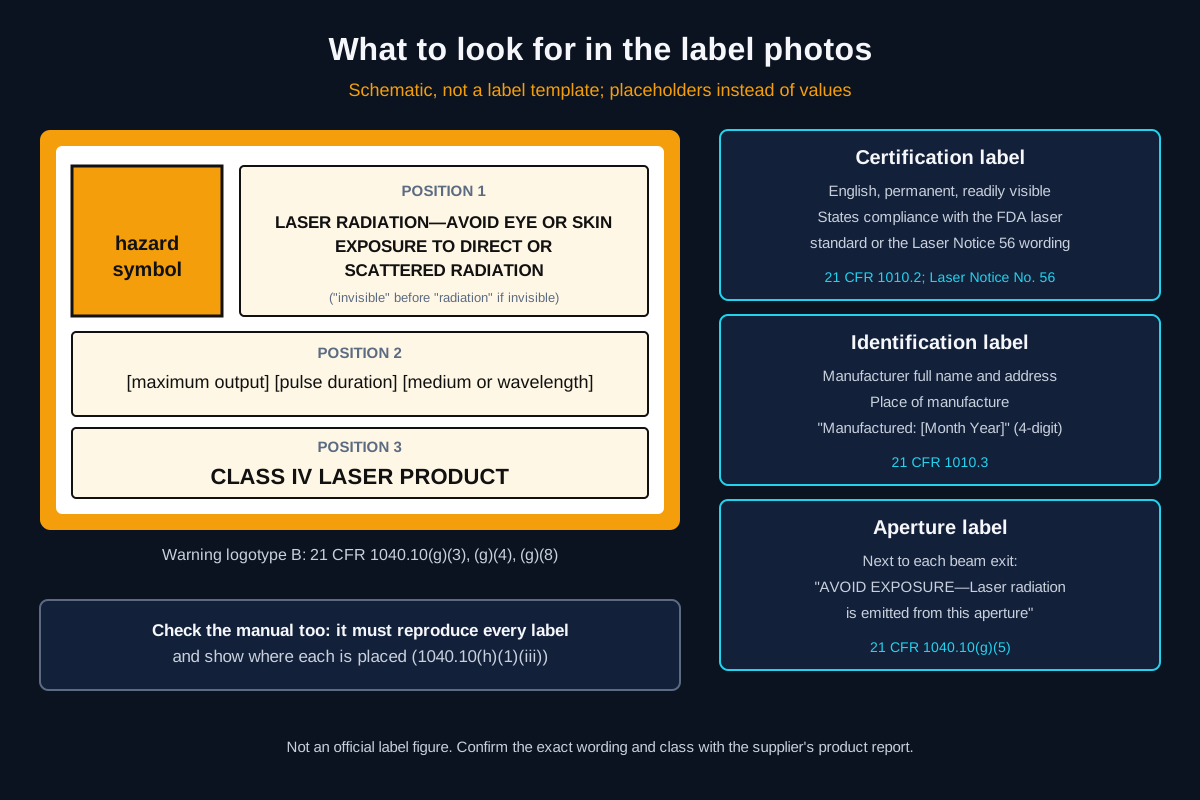
Labels are the easiest documents to check before shipment, because a photo shows most of what the rules require. Ask for clear photos of every label on the machine, with each label's position marked. Under 21 CFR 1010.2, the certification must be a label or tag permanently affixed or inscribed, legible and readily visible when the product is assembled for use, and in English. Under 21 CFR 1010.3, the identification label gives the manufacturer's full name and address and the place and month and year of manufacture, with the month written out and the year in four digits, in the form "Manufactured: (month and year)".
If the machine is Class IV, 1040.10(g) sets the warning label wording and the output data it carries. If the supplier certifies through IEC 60825-1 Ed. 3 under Laser Notice No. 56, the certification label wording changes, but the label itself remains. Laser Notice No. 56 lists 1010.2 certification, 1010.3 identification, the purchasing and servicing information in 1040.10(h)(2) and the modification rule in 1040.10(i) among the requirements the guidance does not affect. The table in this section lists what to look for.
For the Laser Notice No. 56 route, FDA gives the certification label statement for laser products that are not medical devices: "Complies with FDA performance standards for laser products except for conformance with IEC 60825-1 Ed. 3., as described in Laser Notice No. 56, dated May 8, 2019." An equivalent version that cites 21 CFR 1040.10 and 1040.11 is also listed. A label that claims only "CE" or "IEC 60825-1" without one of these statements is a question to put to the supplier before shipment, not after.
| Label | What the rule text asks for | What to check in the photo |
|---|---|---|
| Certification | Permanent, legible, readily visible label or tag in English (1010.2) | A statement of compliance with the FDA laser standard, or the Laser Notice 56 wording for IEC 60825-1 Ed. 3 |
| Identification | Manufacturer's full name and address; place and month and year of manufacture (1010.3) | "Manufactured:" with the month spelled out and a four-digit year; the name matches the acknowledgement letter |
| Class IV warning | Warning logotype B with "LASER RADIATION—AVOID EYE OR SKIN EXPOSURE TO DIRECT OR SCATTERED RADIATION" and "CLASS IV LASER PRODUCT" (1040.10(g)(3)) | Both lines present on the logotype |
| Output data | Maximum output, pulse duration when appropriate, and laser medium or wavelength at position 2 (1040.10(g)(4)) | Values filled in, not blank or "see manual" |
| Aperture | "AVOID EXPOSURE—Laser radiation is emitted from this aperture" near each aperture (1040.10(g)(5)) | A label next to the cleaning head or beam exit |
| Invisible radiation | The word "invisible" before "radiation" when the radiation is invisible (1040.10(g)(8)) | Consistent with the wavelength stated at position 2 |
Evidence: 21 CFR 1010.2 certification (eCFR) · 21 CFR 1010.3 identification (eCFR) · 21 CFR 1040.10 (eCFR) · FDA Laser Notice No. 56
Document 3: the user manual and the spec sheet
The manual is a regulated document, not just an operating guide. Under 1040.10(h)(1), the user information must include adequate instructions for assembly, operation and maintenance with clear warnings about exposure, and a maintenance schedule. It must also state the pulse durations, maximum radiant power and, where applicable, maximum energy per pulse of the accessible laser radiation. It must include legible reproductions of every required label, showing where each one is placed, and a list of controls and procedures with the warning "Caution—use of controls or adjustments or performance of procedures other than those specified herein may result in hazardous radiation exposure." Ask for the manual in English before purchase and check it against that list.
The spec sheet and brochure count too. Under 1040.10(h)(2), catalogs, specification sheets and descriptive brochures must carry a legible reproduction of the class designation and warning, including the information for positions 1 to 3 of the logotype. If the quotation spec sheet shows no class or output data, ask why.
The manual should also describe the performance features that 1040.10(f) requires for the class. For a Class IIIb or IV laser system, these include a remote interlock connector, a key-actuated master control whose key is removable and leaves the laser inoperable when removed, and an emission indicator that signals before emission. Class II, III and IV laser systems also need a beam attenuator, and a Class IV laser system made after August 20, 1986 needs a manual reset after a remote-interlock interruption or a loss of main power. Housing parts designed to be removed during operation or maintenance need safety interlocks where removing them could expose someone to hazardous laser radiation. The manual shows that the features exist. Checking that they work at your site is a commissioning task, not a document check.
Evidence: 21 CFR 1040.10 (eCFR)
Document 4: what the importer declares at the border
For radiation-emitting products subject to a federal performance standard, Form FDA 2877 must be submitted at the time of entry. FDA says that, where applicable, it verifies the manufacturer, report accession number, model designation and annual report declared at entry. It also checks its import alert database. Import alert 95-04, for example, lists certain laser products that fail to comply with the performance standards and reporting requirements. FDA's FAQ adds that products without the certification label or tag required by 1010.2 shall be refused entry.
Declaration B on the form is the one a compliant machine normally uses. It states that the products comply with the performance standards applicable at their date of manufacture and that a certification label is affixed to each product, and it records the accession number of the report and the manufacturer of record. The form's instructions ask for the FDA Establishment Identifier of the manufacturer that filed the report and for the accession number to be sent with affirmation of compliance code ACC. The importer of record signs it. The form warns that a knowingly false declaration can bring a fine of up to $10,000 or up to 5 years' imprisonment, and that importing a non-compliant product can bring civil penalties of $1,000 per violation, up to $300,000 for related violations. Declarations C and D cover noncompliant products held under bond for research, training or demonstration, or until they are brought into compliance under an FDA-approved plan. The instructions also say Class IIIb and IV lasers may not be operated at trade shows.
One more document belongs to the foreign manufacturer. Under 21 CFR 1005.25, a manufacturer must designate a permanent US resident as its agent before offering products for import, and FDA says the US agent should be identified when the product report is prepared. Ask the supplier who that agent is, and give your customs broker the accession number, the manufacturer of record, the FEI and the model list before the machine ships.
Evidence: FDA: Importing radiation-emitting electronic products · Form FDA 2877 · FDA: Getting a radiation-emitting product to market (FAQ) · 21 CFR 1005.25 US agent (eCFR)
If you integrate or modify the laser, you may become the manufacturer
Certification covers the product as certified. Under 1040.10(i), when a business that manufactures, assembles or modifies laser products changes a certified product in a way that affects its performance or intended function under the standard, the change counts as manufacturing. The business that made the change must then recertify and reidentify the product under 1010.2 and 1010.3. This matters when a laser source is built into an enclosure, a robot cell or a production line.
There is a narrower path for products that incorporate a certified laser system without changing it. Under 1010.2(e), such a product can rely on the incorporated system's certification if several conditions are met. The system must not be a laser product intended for use as a component or replacement under 1040.10(a)(1) and (2), must not be modified as defined in 1040.10(i), and must keep all of its 1040.10(f) performance features available. Its required labels must be visible on the outside, it must be installed according to the laser manufacturer's instructions, and the user must receive the required user information. Before you integrate, ask the supplier for those installation instructions and label reproductions, and ask your integrator which path applies.
These rules cover manufacturing. FDA notes that for most electronic products, CDRH regulates manufacture while the states regulate use, so site controls, training and operating approval are separate work.
Evidence: 21 CFR 1040.10 (eCFR) · 21 CFR 1010.2 certification (eCFR) · FDA: Getting a radiation-emitting product to market (FAQ)
Plan the site safety and extraction controlsIf the machine is also placed on the EU market: CE declaration and technical file
A CE-marked machine comes with an EC declaration of conformity, and Annex II, part 1, Section A of Directive 2006/42/EC lists what that declaration must contain. It needs the manufacturer's business name and full address, and the name and address of the person authorized to compile the technical file, who must be established in the Community. It must describe and identify the machinery, including model, type and serial number. It must include a sentence declaring that the machinery fulfils the Directive, with the other Directives it complies with. Where they apply, it must name the notified body and the harmonized standards used. It also needs the place and date and the identity and signature of the person empowered to sign. The declaration covers the machine as placed on the market, not parts added or work done later by the user.
The technical file behind it, described in Annex VII, includes the risk assessment, the standards applied, test reports and copies of the instructions and the declaration. It does not have to be located in the EU or handed to a buyer, but it must be assembled and made available on a reasoned request from the authorities, and kept for at least 10 years. So the practical request is confirmation of who holds the file, not the file itself. Annex I also sets out the laser-specific requirement, section 1.5.12. Laser equipment on machinery must be designed to prevent accidental radiation and protected so that effective, reflected, diffused and secondary radiation do not damage health, and any optical equipment for observing or adjusting it must create no health risk from laser radiation. Instructions must be supplied in the official language or languages of the Member State where the machine is used.
The legal basis changes on January 20, 2027. Regulation (EU) 2023/1230 applies from that date, and Directive 2006/42/EC is repealed with effect from the same date. The Regulation's original text said January 14, 2027, and a corrigendum published in the Official Journal on July 4, 2023 corrected it to January 20. Machinery placed on the EU market before January 20, 2027 must comply with the Directive, and the Commission notes that its declaration may also state conformity with the Regulation where that applies. Products placed on the market in conformity with the Directive before that date may still be made available afterward. Under the Regulation, an EU declaration of conformity follows Annex V. It identifies the product and its manufacturer, states that it is issued under the manufacturer's sole responsibility, lists the Union legislation and the harmonized standards or specifications applied, including their dates, and names a notified body where one was involved. One declaration must cover all the Union acts that apply. Instructions and the declaration may then be supplied in digital form, with the digital declaration accessible for at least 10 years. Laser classification is covered by IEC 60825-1, whose current edition 3.0 (2014) applies to laser products emitting between 180 nm and 1 mm.
Evidence: Directive 2006/42/EC (EUR-Lex) · Regulation (EU) 2023/1230 (EUR-Lex) · Corrigendum to Regulation (EU) 2023/1230, OJ L 169, 4.7.2023 · European Commission: Machinery · IEC 60825-1:2014
The request-and-check list
The table and list in this section combine the checks above into a single request you can send to a supplier. They are an editorial checklist drawn from the rule text, not a legal checklist, and your importer or advisers may need more.
- Ask for every document for the exact model and configuration on the quotation, not for a product family in general.
- Check that the manufacturer's name matches across the acknowledgement letter, the identification label and Form FDA 2877.
- Ask before purchase whether the machine will be integrated or modified, and who will recertify it if 1040.10(i) applies.
- Send the full set to your importer of record and customs broker before the machine ships, and ask a notified body or counsel for any EU conformity question.
| Request | Check it against | Common problem |
|---|---|---|
| CDRH acknowledgement letter with the accession number | 21 CFR 1002.10; FDA FAQ on accession numbers | A number with no letter, or a letter naming a different manufacturer |
| Model coverage (product report, supplements or annual report) | Form FDA 3632 reporting guide | The quoted model is not in the reported family |
| Photos of certification and identification labels | 21 CFR 1010.2 and 1010.3; Laser Notice No. 56 wording | Missing month/year, or "CE" only with no FDA statement |
| Photos of warning and aperture labels | 21 CFR 1040.10(g) | Class IV wording or position 2 output data missing |
| English user manual and spec sheet | 21 CFR 1040.10(h) | No label reproductions, emission data or controls warning |
| Form FDA 2877 inputs: accession number, manufacturer of record, FEI, models | Form FDA 2877 Declaration B | Importer asked to sign without the data |
| Name of the manufacturer's US agent | 21 CFR 1005.25 | No agent designated |
| EU declaration of conformity (if also placed on the EU market) | 2006/42/EC Annex II 1.A, or 2023/1230 Annex V from January 20, 2027 | A "certificate" offered instead of a declaration |
Evidence: 21 CFR 1002.10 product reports (eCFR) · 21 CFR 1010.2 certification (eCFR) · 21 CFR 1040.10 (eCFR) · Form FDA 2877 · Directive 2006/42/EC (EUR-Lex) · Regulation (EU) 2023/1230 (EUR-Lex)
Compare the machine familiesWhat to send LaserLuma with a quotation request
The document list depends on the machine, so start with the application. LaserLuma's quotation form asks for the cleaning application, the material and contaminant, the work area or part geometry, the next step you want and your country. The equipment range page says final configurations are validated against the actual application and confirmed in the quotation.
When you send the enquiry, name the destination country, say whether the machine will be imported by you or by a distributor, and list the documents from the table above that your importer or broker needs. This guide does not state that any LaserLuma configuration holds a particular certification or has a particular report on file. Which documents exist for a quoted machine is confirmed for that configuration during the quotation, and the compliance position stays with your importer and your advisers.
Evidence: FDA: Getting a radiation-emitting product to market (FAQ) · European Commission: Machinery
Request a quotation with your document listFAQs
Does the FDA approve or certify laser cleaning machines?
No. The manufacturer certifies that its laser product complies with FDA's performance standard, based on its own testing program, and FDA does not approve the product or the certification. CDRH sends an acknowledgement letter with an accession number when it receives a product report, and FDA says neither the letter nor the number is an approval.
What is an FDA accession number for a laser product?
It is the unique number CDRH assigns to a radiation safety report when it is received. It appears in the acknowledgement letter, and FDA import staff use it to confirm that the manufacturer has, at a minimum, met the self-certification and reporting requirements for the product being imported.
What is a CE certified machine?
For machinery, CE marking follows the manufacturer's conformity assessment and an EC declaration of conformity, with a notified body involved only where the procedure requires one. The European Commission warns that voluntary certificates from bodies not acting as notified bodies are not recognized proof of compliance, so ask for the declaration of conformity rather than a certificate.
What documents do I need to import a laser cleaning machine into the US?
Your importer of record normally needs the information for Form FDA 2877, including the report accession number and manufacturer of record. The machine also needs its English certification and identification labels. The foreign manufacturer must have designated a US agent. Confirm the complete list for your shipment with your customs broker.