Process comparison
Laser, Plasma or Dry Ice Cleaning? Choose Your First Trial
Compare laser, plasma and dry ice cleaning by the result your job needs. Shortlist a representative first trial and separate removal from functional acceptance.
9 min readBy LaserLuma
Published
Choose the first cleaning trial by the result the next manufacturing step needs. If the question is removal from a defined area, investigate a representative laser-removal trial. If surface chemistry and organic contamination matter, include a suitable plasma process in the shortlist. If a blasting process fits the part and its access constraints, investigate dry ice with that supplier. These are starting questions, not a ranking: the same clean-looking surface can leave very different evidence about removal, substrate condition and readiness for the next process. This comparison helps you specify the first sample trial and its acceptance evidence. It does not establish a universal winner or report a LaserLuma head-to-head experiment. The application owner must define what counts as acceptable; the process supplier must assess the actual contamination, material, geometry and configuration.
Define what the next process needs
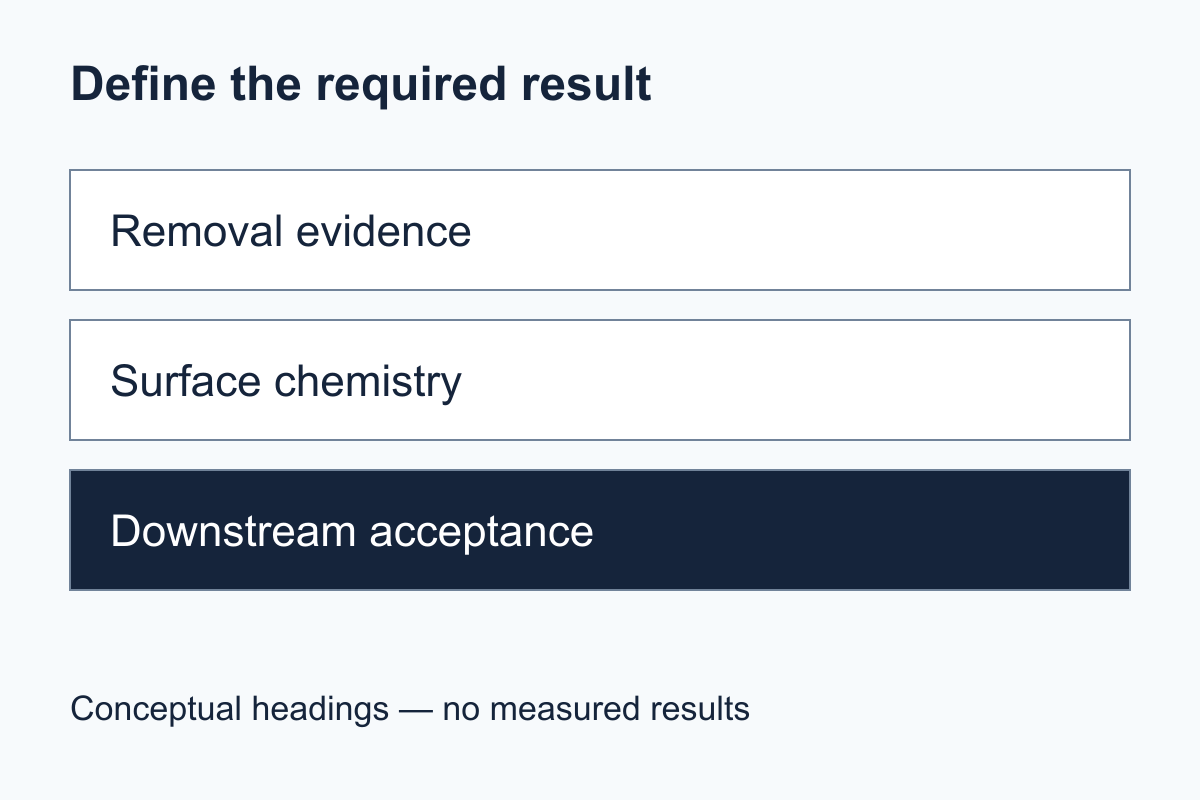
Write the required outcome before asking a supplier which method is best. Removing a coating from a particular area is a different task from changing surface chemistry before bonding. A surface may look cleaner without having demonstrated the functional result your next process needs. Conversely, a surface-chemistry treatment needs an acceptance check that addresses that purpose, rather than a photograph alone.
For the first trial, separate three evidence headings: what was removed, what changed in the substrate, and whether the intended downstream function was achieved. You do not need to impose the same test on all three methods. You need to preserve the same application question and use tests that can answer it.
Consider laser when the trial needs targeted removal
Laser cleaning uses laser energy to remove surface contaminants. Start by identifying the material to remove and the surface to preserve. A trial on a representative area can then address whether the proposed configuration delivers the required removal without an unacceptable change to that particular part. A promising result on another coating or another substrate does not settle this question.
The Laserax discussion of laser and plasma cleaning describes the laser mechanism and applications, but also contains vendor comparative claims. This guide uses the mechanism context; it does not adopt its comparative speeds, weld results or claims of universally complete removal. Ask for evidence on your own sample and acceptance objective.
Evidence: Laserax discussion of laser and plasma cleaning
Keep method choice and equipment purchase as separate decisions. Once a laser trial has a meaningful objective, the existing laser rust-removal equipment selection guide covers equipment considerations for that narrower application. This comparison does not prescribe power, wavelength or a processing recipe.
laser rust-removal equipment selection guideConsider plasma when surface chemistry is part of the job
Plasma cleaning is more than a synonym for stripping a visible layer. Harrick's explanation of plasma cleaning describes organic-contamination removal and the introduction of surface chemical functional groups. It also explains that the process gas affects the reactions and groups introduced. That distinction matters when the next step depends on surface behavior, rather than removal appearance alone.
Evidence: Harrick's explanation of plasma cleaning
The source discusses tabletop laboratory and research systems. Its examples cannot establish the throughput, geometry coverage or bonding performance of another plasma installation. Identify the actual plasma configuration with the supplier, then define the surface or downstream check that addresses your job. Do not transfer a contact-angle result from a published example to your production part.
If your concern is a bond or coating, keep that functional requirement in the record. A cleaner photograph and a surface-chemistry measurement can each be useful, but neither automatically demonstrates that the finished joint or coating meets its own acceptance criteria. This is a reason to define the endpoint, not a reason to rule plasma in or out for every material.
Consider dry ice as a blasting trial with its own constraints
Cold Jet's dry-ice blasting explanation describes solid carbon dioxide media delivered with compressed air and sublimating during the process. This makes the media behavior different from a retained abrasive. It does not show that the contamination removed from the workpiece disappears, or that the job needs no collection or cleanup.
Evidence: Cold Jet's dry-ice blasting explanation
Ask the supplier to assess representative contamination, part access and the areas that must remain unchanged. Keep the actual removal result and substrate condition in the trial record. The manufacturer page's broad claims about harmlessness, operator safety or environmental benefit are not substitutes for application evidence, and this guide does not transfer them to your part.
Dry ice also brings carbon dioxide into the site review. OSHA's carbon-dioxide information identifies the substance and its occupational exposure context. Have the responsible site personnel and supplier review the proposed process and location before a trial. This article does not prescribe exposure limits, ventilation design or safe operating instructions.
Evidence: OSHA's carbon-dioxide information
Choose a first trial without declaring a universal winner
Shortlist by the missing evidence. A removal problem should begin with a supplier assessment of the contaminant and area to treat. A surface-chemistry question should include a process and measurement that can address that question. Where blasting is a plausible route, assess access, part constraints and the site requirements with that supplier. More than one process may remain worth investigating; a combined or sequential route is not excluded by these headings.
Write down why a method enters the shortlist and what result would justify the next step. That makes the first trial useful even when it does not produce an acceptable result: the record can explain whether the method needs a revised test, another route should be investigated, or missing acceptance evidence keeps the decision on hold.
- Required result: identify removal, surface-chemistry change or downstream functional acceptance, and state which evidence is currently missing.
- Representative sample: describe the contamination, base material, geometry and relevant variation; identify what the sample does not represent.
- Preservation constraints: identify areas and properties that must stay within the application owner's criteria.
- Method rationale: state why laser, plasma or dry ice is a plausible first trial for this particular question, subject to the supplier's assessment.
- Laser candidate: ask how the target area will be reached and what evidence will show that adjacent or underlying material stays within your criteria. Keep the candidate on hold while the supplier cannot define that removal-and-preservation question for the actual part.
- Plasma candidate: ask which configuration addresses the actual organic contamination or surface-chemistry requirement, and which check will distinguish the desired change from appearance alone. Hold a comparison based only on a clean photograph when the job requires a different endpoint.
- Dry-ice candidate: ask how the proposed nozzle access, media and air supply, removed contamination and carbon-dioxide site review will be addressed. Keep unresolved feasibility or site requirements visible instead of treating sublimation as evidence that the trial is ready.
- Decision conditions: define what evidence allows a further trial, what requires revision, and what keeps the decision on hold.
Use the same evidence headings, with different acceptance tests
A fair comparison does not require pretending the processes do identical work. Keep the application objective, representative sample condition and owner criteria visible, then record how each supplier investigated them. If one sample was assessed only for removal appearance and another for bonding performance, those results answer different questions; they do not establish the best method for your production job.
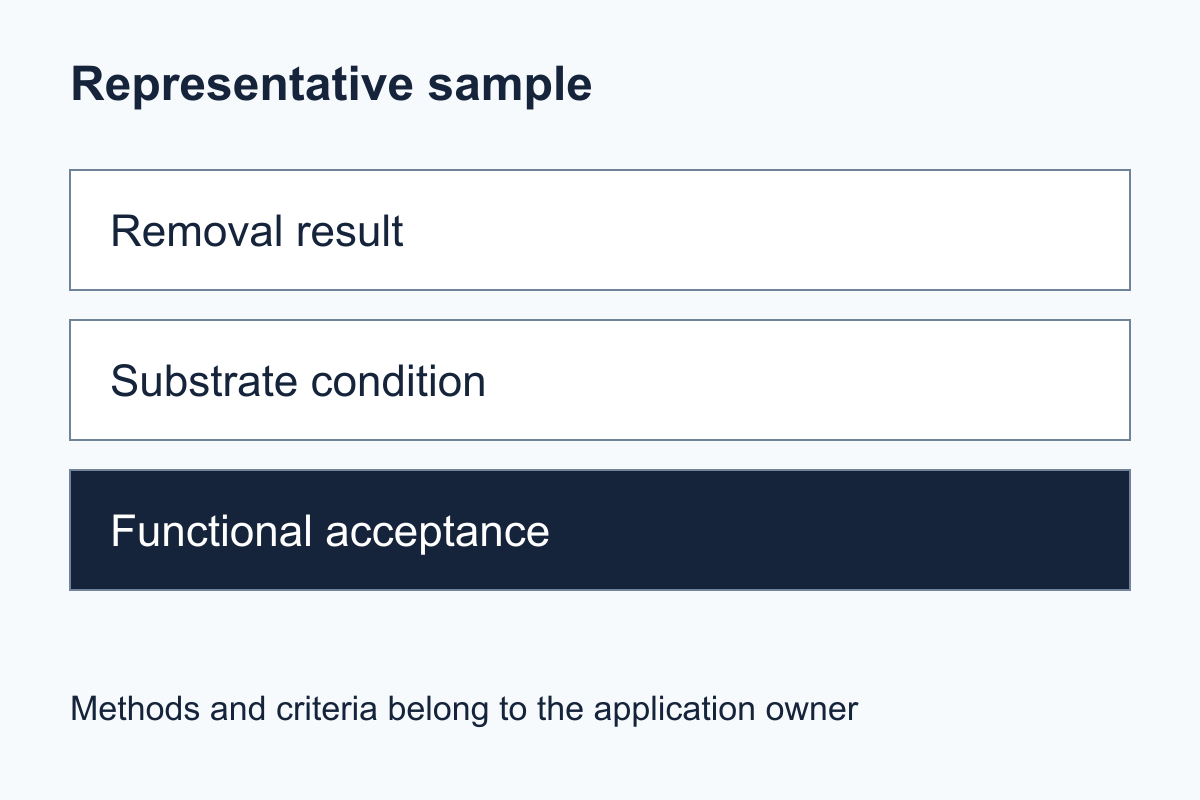
The following record is a planning aid, not a prescribed laboratory protocol. Use the application owner's methods and criteria for removal, substrate change and function. Record a missing result as missing rather than converting it into a pass. A first trial supports the next investigation; it does not by itself authorize production use.
- Sample identity and condition: material, contamination, geometry, relevant variation and the area evaluated.
- Process configuration: supplier, method and the actual documented configuration used for that sample; keep unlike setups visible.
- Removal evidence: what was removed, what remained and how the result was assessed against the required endpoint.
- Substrate-condition evidence: what was inspected or measured, the applicable criteria and any unresolved change.
- Functional evidence: the relevant downstream check, result and owner criterion; use not applicable only when there is a real reason.
- Handling and site constraints: relevant access, collection, containment or other requirements identified by the responsible supplier and site review.
- Next decision: advance to a further trial, revise the investigation or hold for missing or unacceptable evidence; record the reason and responsible owner.
Prepare a bounded laser sample-testing request
If laser removal belongs in your shortlist, use the laser sample-testing request to describe the job rather than ask for a generic three-method winner. Include the contamination and base material, a representative sample or photographs, the geometry and area to preserve, the result you need, and the application owner's acceptance method and criteria.
laser sample-testing requestLaserLuma's enquiry path supports a laser-side application discussion. It does not establish that LaserLuma supplies plasma or dry-ice equipment, has already tested your part, or can certify the downstream process. Keep the request focused on what a laser trial should investigate and what evidence you would need before deciding to go further.
FAQs
Which cleaning method should be tested first?
Start with the result your job needs and the evidence that is missing. Investigate removal with a supplier who can assess the contaminant and substrate; include a suitable plasma process when surface chemistry is part of the requirement; assess dry ice as a blasting route where the part and site constraints make it a plausible candidate. These are conditional starting points, not a universal order.
Is plasma cleaning only a way to remove contamination?
No. Harrick's manufacturer explanation describes organic-contamination removal and changes to surface functional groups, depending on the process gas. Its laboratory context does not prove that another configuration will meet your downstream requirement, so define that requirement and its acceptance check separately.
Does sublimating dry ice mean there is no waste to collect?
No. Sublimation describes the carbon dioxide media. It does not establish what happens to contamination removed from the part. Ask the supplier and responsible site personnel to address the actual residue, collection and process-location requirements for the proposed trial.
Can one trial establish a universal winner?
No. A representative first trial can support a next decision for its recorded conditions and criteria. Comparing different sample conditions or different endpoints cannot establish a general ranking. Keep removal, substrate condition and functional evidence separate, and hold a decision when required evidence is missing.