Process selection
Hybrid Pulsed + Continuous Laser Cleaning: What to Verify Before Buying
Compare application-specific hybrid laser cleaning evidence, verify the quoted beam configuration and usable modes, and test the job mix before weighing the added cost.
10 min readBy LaserLuma technical team
Published
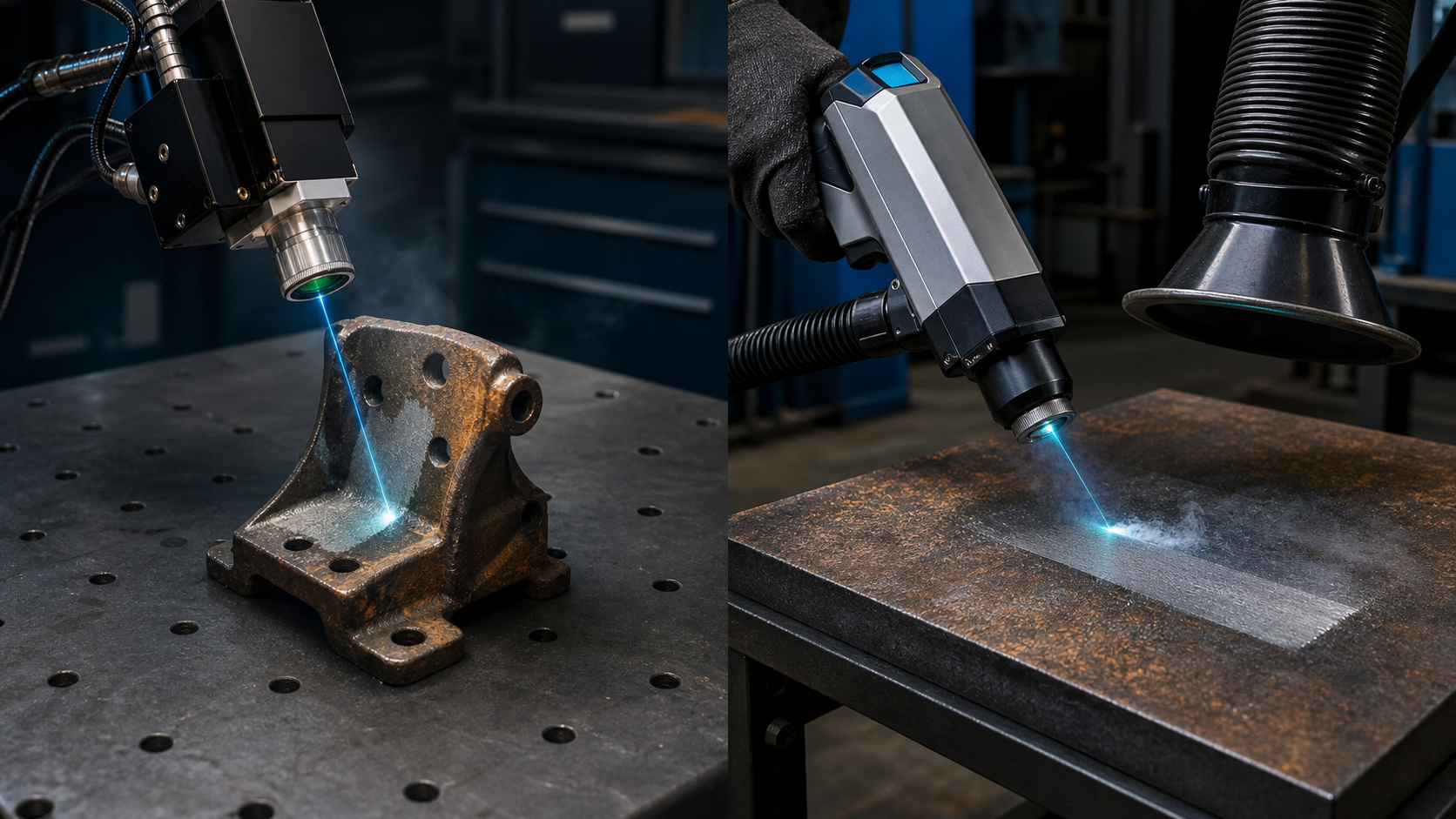
A mixed job list can justify evaluating a hybrid pulsed+continuous laser cleaning system, but it does not prove that the system will cover every job or repay its added cost. First verify what the quoted equipment actually does: how its beams are arranged, whether either source can operate independently, and which recipes the supplier has validated. Then compare representative tests and complete quotes against a suitable single-mode machine, two machines, or outsourcing. This guide separates application-specific process evidence from those equipment and financial questions.
Start with your job list, not the machine spec sheet
Before comparing machines, write down the actual jobs the equipment will run in a typical month: substrate type, contamination or coating, area per job, heat sensitivity, and schedule pressure. Treat that list as a set of tests a supplier must satisfy. A combined-beam process and a machine with independently selectable modes are different capabilities; do not assume the word hybrid promises both. Recurring varied work is a reason to investigate, while acceptable test results and the shop's own cost comparison determine whether to buy.
This is a different question from choosing which process to test first on a single part, and a different question from choosing a portable or fixed-line machine for one on-site job. If the immediate need is a single-job test decision, the per-job process-selection guide answers that directly. If the immediate need is choosing equipment format for one on-site job, the on-site equipment-format guide answers that instead. This guide is about a capital-equipment decision across the whole job list, not any single job.
Read the per-job process-selection guideWhat hybrid capability actually does inside the machine
The two studies below use pulsed and continuous-wave energy in application-specific ways. They do not establish one universal sequence, beam arrangement, or set of selectable machine modes. Ask a supplier to describe those details for the actual configuration being quoted.
In the Q235B carbon-steel oxide study, pulsed cleaning came before continuous laser treatment. The authors reported 5.7 mg oxide removal with integrated treatment versus 3.7 mg with the pulsed treatment, about 54% more in that experiment. They attributed the lower roughness to continuous-laser remelting after pulsed cleaning: melted metal backfilled craters created by the pulsed treatment. That is a reported result for this steel and test setup, not a promise of damage-free cleaning or a general performance uplift.
A separate N52B30 engine-piston study describes continuous-wave energy providing thermal assistance by softening the carbon deposit and reducing its interfacial bond strength, while pulsed energy vaporizes and ejects the softened material. The paper reports an optimized result of 0.947 micron surface roughness and 3.67% carbon residue at 625.8 W CW power, 250.08 W pulsed power, 15.00 mm/s Y-direction cleaning speed and 31.54 kHz pulse repetition frequency. These are the paper's application-specific optimization results. The account of thermal assistance followed by material removal should not be read as proof that every commercial hybrid machine uses two separate sequential passes.
Keep the cases separate: the steel study uses continuous treatment after pulsed cleaning to alter the surface; the piston study describes CW thermal assistance for pulsed removal of carbon deposits. Neither paper establishes that an unspecified machine can switch between independent pulsed-only, CW-only and combined operation for a shop's other jobs. Verify the quoted capability and test each important substrate and contamination combination before using either result in a buying decision.
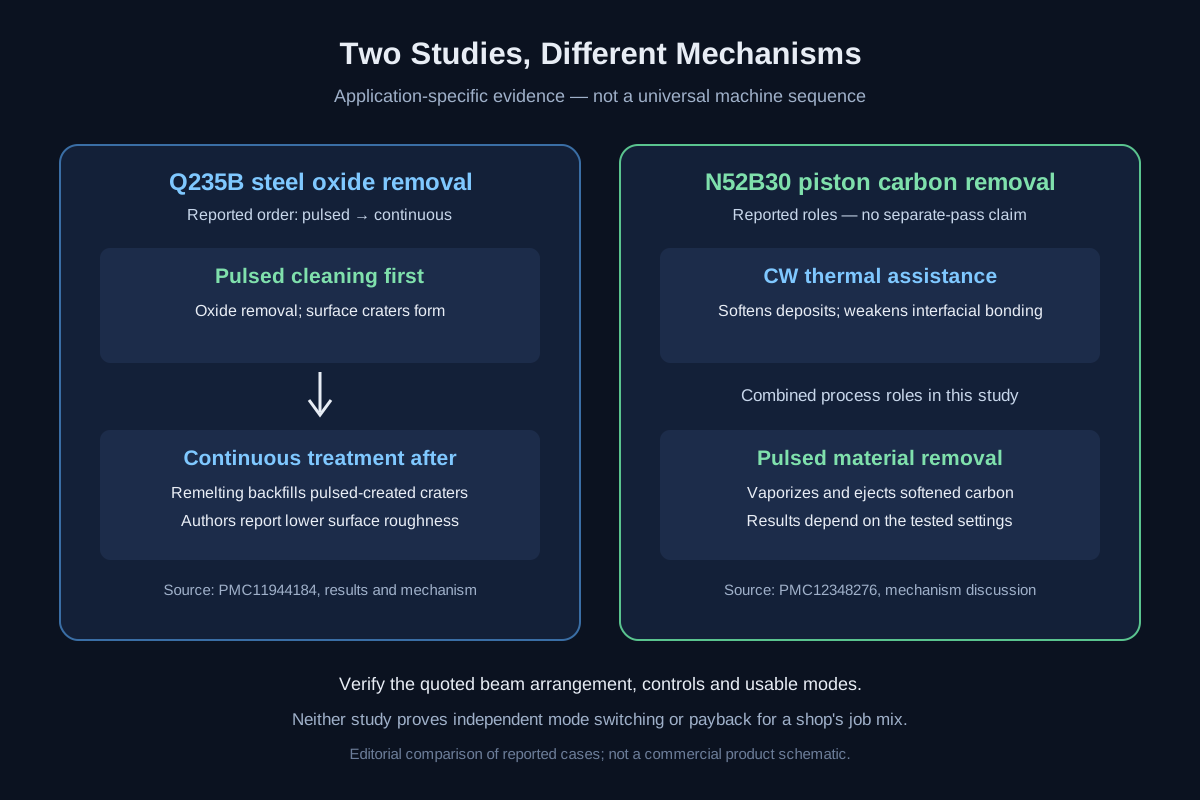
Evidence: Oxide removal and roughness improvement, integrated pulsed-continuous cleaning of Q235B carbon steel (peer-reviewed, open access) · Hybrid CW+pulsed cleaning optimization for engine piston carbon deposits (peer-reviewed, open access)
When a single-mode machine is still the better buy
Job-mix diversity is not automatically a reason to buy hybrid. Laser Focus World reported a bench comparison in which MOPA pulsed cleaning ran about 7.7 times faster on aluminum (2.77 versus 0.36 square meters per hour) and about 3.5 times faster on steel (1.06 versus 0.3 square meters per hour), while CW treatment increased roughness through localized melting. Those are reported results for that comparison, not universal rankings. If a suitable single-mode machine meets the shop's actual quality and throughput requirements, compare its complete quote with the hybrid alternative rather than assuming more capability is better value.
For a largely uniform job list, identify what a combined process would improve and whether that improvement matters to the next production step. For varied work, ask whether the quoted system can perform each required operation and what recipe development, commissioning and training it needs. Compare those requirements with the equipment already available; recurring job diversity alone does not establish a payback.
Compare the buying signals side by side
Use these as screening questions for supplier trials, not validated capability zones or a prediction of price or payback.

| Decision point | Favors pure pulsed | Favors pure continuous | Favors evaluating hybrid |
|---|---|---|---|
| Job-mix diversity | Mostly detailed, precision or heat-sensitive work | Mostly large, robust, heavily-fouled work | Regularly includes both categories in the same period |
| Throughput pressure | Moderate-area work where surface quality matters most | High-area work where removal speed matters most | Both pressures exist on different jobs, swapping machines is impractical |
| Substrate sensitivity range | Consistently heat-sensitive or thin | Consistently robust with thermal margin | Varies widely across the job list |
| Operational complexity tolerance | Verify recipes and training for the actual pulsed jobs | Verify recipes and training for the actual CW jobs | Verify source controls, usable modes, recipes and training for the quoted configuration |
| Capital budget | Compare the complete pulsed-system quote | Compare the complete CW-system quote | Compare complete quotes and expected utilization; no assumed premium or payback |
| Best proof | Representative sample test on the actual delicate part | Representative sample test on the actual robust part | Representative sample tests across the full job-mix range |
What the added complexity actually costs
The sources reviewed for this guide do not provide a transferable purchase-price premium or hours-per-week payback threshold for a shop's job mix. This is a limit of the evidence used here, not a claim that no cost study exists anywhere. Compare complete supplier quotes, expected utilization, labor, floor space, commissioning, training and existing equipment against two single-mode machines or outsourcing the minority jobs.
The cited manufacturer page describes one composite configuration with 2000 W continuous and 300 W pulsed sources for heavy rust and paint removal. Treat that as the vendor's description of that product, not an independently verified benchmark, a current quotation, or evidence of another supplier's capability. Ask which sources can operate alone, how combined operation is controlled, and what the quote includes. Establish the actual commissioning and training requirements before comparing cost; two source ratings do not by themselves establish useful flexibility.
Safety and extraction don’t change just because the mode does
The hybrid label is not evidence that laser, fire or plume hazards have been removed. Assess the actual CW, pulsed and combined operating configurations with the site's competent laser-safety professional, using applicable guidance such as OSHA's laser hazard resources. Confirm controls for direct and reflected radiation, access, beam termination and the material being removed; do not infer a lighter control requirement from a combined-process demonstration.
Verify extraction for the actual material, removal process and intended operating configurations. A source wattage or an average of two ratings is not an extraction design; require a job-specific assessment and verification.
Evidence: OSHA laser hazards and control standards
Turn job-mix data into a supplier conversation
A useful next step is a written job-mix summary: list representative jobs by substrate, contamination or coating type, area, heat sensitivity and monthly frequency, plus existing equipment. Ask the supplier to map those jobs to the quoted operating configurations and acceptance criteria. Then request tests across the important combinations and compare the complete quote with the alternatives.
- List every distinct job type by substrate, contamination, area and heat sensitivity.
- Note how often each job type recurs per month, not just whether it exists.
- Flag which jobs are currently underserved by any single-mode equipment already on hand.
- Ask which sources can operate independently and how combined beam delivery and recipes are controlled.
- Ask any hybrid-system supplier for a sample test across the full job-mix range, not one part.
- Compare the complete quote — machine, commissioning, training and extraction — not just headline wattage.
FAQs
Is a hybrid pulsed+continuous laser cleaner just two lasers bolted together?
The quoted configuration matters more than the label. In the steel study, continuous treatment after pulsed cleaning remelted metal to backfill pulsed-created craters. The piston study describes CW thermal assistance and pulsed removal of carbon deposits. Those different cases do not establish a universal sequence or independent selectable modes; ask how the actual sources, beam delivery and controls work.
Does hybrid capability guarantee faster cleaning than a single-mode machine?
No. The cited studies and trade-press comparison report results for particular substrates, deposits and settings. Compare acceptable quality and measured throughput on the shop's representative jobs; neither a combined process nor an extra source guarantees better results than a suitable single-mode machine.
How much more does hybrid capability cost than a single-mode machine?
The sources reviewed for this guide do not establish a transferable price premium or payback period. Obtain complete quotes for the actual configurations, then include utilization, labor, commissioning, training and extraction in a shop-specific comparison. The cited vendor configuration is not a price or payback benchmark.
Do hybrid systems need different safety controls than single-mode machines?
Assess the actual CW, pulsed and combined configurations, beam delivery and material hazards. The hybrid label does not establish equivalent or reduced risk. Applicable laser-hazard guidance and the site's competent laser-safety professional should inform the controls and job-specific extraction verification.