Equipment selection
How to Choose a Pulse Laser Cleaning Machine: Power, Beam, and Cooling
Choose a 100–1000 W pulse laser cleaning machine for metal by matching power tier, MOPA pulse control, top-hat vs. Gaussian beams, cooling, F100–F420 lenses, and Class 4 safety.
8 min readBy LaserLuma technical team
Published
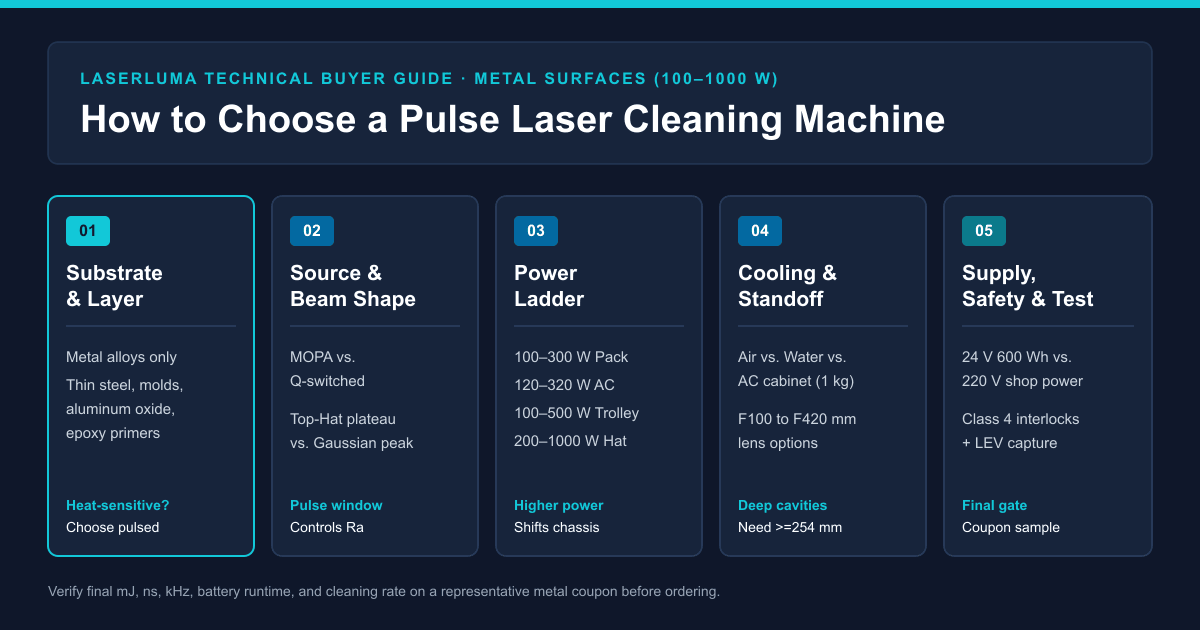
Deciding how to choose a pulse laser cleaning machine for metal requires matching substrate heat sensitivity, beam profile (Gaussian or flat-top), pulse control (MOPA or Q-switched), cooling, lens standoff, and site power rather than sizing by wattage alone. Where pulsed ablation beats continuous-wave heating, evaluate LaserLuma's pulse laser cleaning machines (100–1,000 W), add Class 4 controls, and test a coupon before ordering.
Selecting the Best Pulse Laser Cleaning Machine Configuration for Metal Work
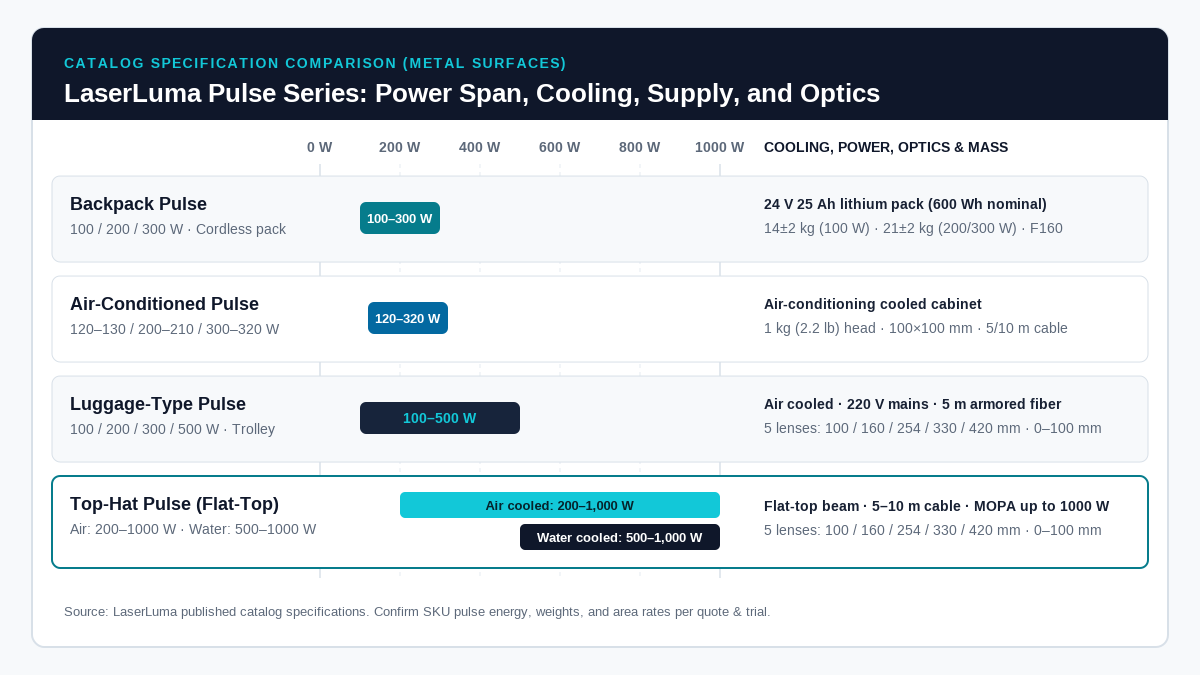
The best pulse laser cleaning machine for an industrial facility aligns hardware limits with part access, heat tolerance, and shop power. LaserLuma's metal-cleaning pulsed catalog (100–1,000 W, excluding wood) spans four series:
- Cordless field work (100–300 W): Choose the 24 V 25 Ah Backpack Pulse (14±2 kg / 31±4 lb at 100 W, 21±2 kg / 46±4 lb at 200–300 W, fixed F160 160 mm lens, 0–100 mm scan) for scaffolds, vessels, and remote frames.
- Warm-bay handheld work (120–320 W): Choose the Air-Conditioned Pulse (120–130 W, 200–210 W, 300–320 W) for refrigerated cabinet cooling, a 1 kg (2.2 lb) handpiece, a 100×100 mm (3.9×3.9 in) field, and 5–10 m cables.
- Mobile 220 V shop work (100–500 W): Choose the air-cooled Luggage-Type Pulse (100–500 W, 220 V, 5 m / 16.4 ft cable, 100–420 mm lenses) near fixed 220 V power.
- Molds, thin alloys, and thick coatings (200–1,000 W): Choose the Top-Hat Pulse (200–1,000 W air-cooled trolleys or 500–1,000 W water-cooled cabinets, 5–10 m cables, 100–420 mm lenses) for flat-top uniformity and higher headroom.
Confirm Pulsed Mode Before Sizing Wattage
For heavy rust or mill scale on thick carbon plate, check mode fit in our pulsed vs. continuous laser cleaning guide. Pulsed delivery curbs heat input on dies and thin sheet, while higher wattage shifts chassis format from backpacks to trolleys or water-cooled cabinets. Request SKU mJ, ns, kHz, battery runtime, trolley weights, voltage options, and area speeds (m²/h) in a written quotation.
How Does Pulse Laser Cleaning Work Inside the Beam-to-Surface Window?
Pulse laser cleaning works by delivering discrete nanosecond bursts separated by brief thermal cooling gaps instead of continuous heating. Pulsed fiber lasers fire thousands of bursts per second (kHz, kilohertz), stripping oxides or coatings while curbing heat soak into metal.
Fluence, Pulse Duration, and Spatial Overlap
Three variables govern a pass: fluence (energy density in J/cm²), pulse duration (pulse width in nanoseconds, ns), and spatial overlap (spot and line overlap percentage). Galvo optics scan at 5–10 m/s or faster per the Narran laser cleaning parameter guide; check parameter math in our laser cleaning fluence and pulse overlap guide.
Peer-Reviewed Evidence: Pulse Width and Overlap Outweigh Wattage
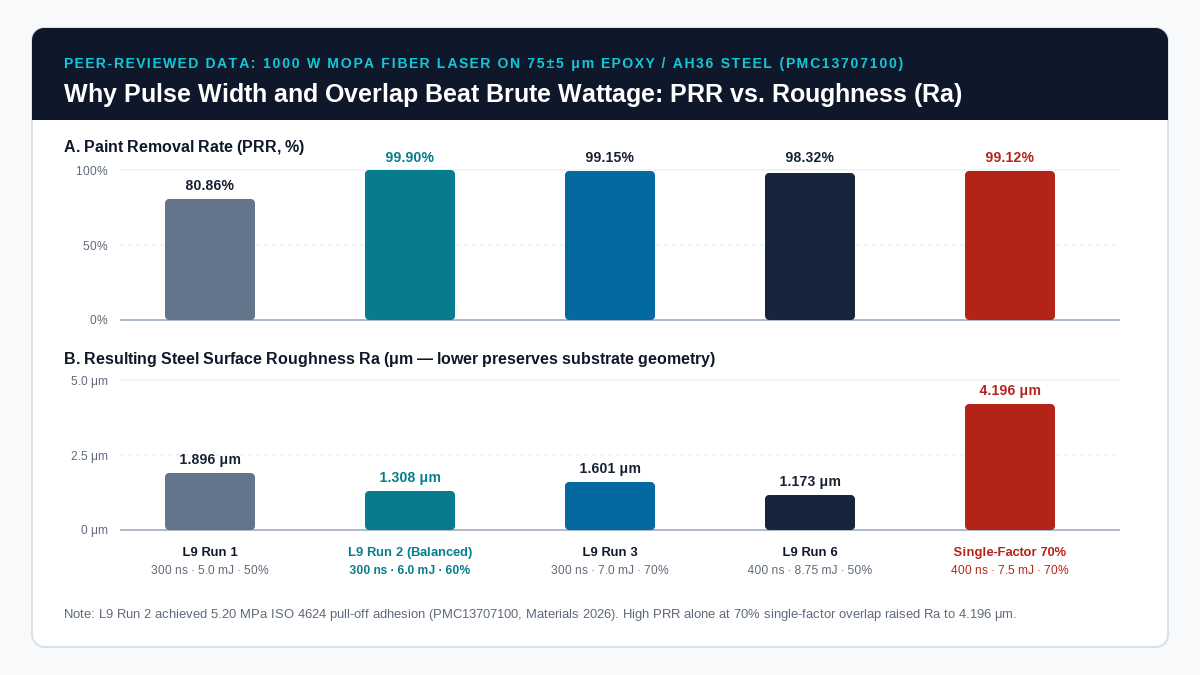
A 2026 Materials study on AH36 steel stripped 75±5 μm epoxy primer using a 1,000 W MOPA laser (1060–1080 nm, 100–500 ns, 66–1,000 kHz, F160 lens, ~250 μm spot). Short 100 ns pulses (6.25 mJ, 50% overlap) hit 55–65% paint removal rate (PRR) with Ra = 1.816 μm pitting (Ra is arithmetic average roughness in micrometers). L9 Run 1 (300 ns, 5.00 mJ, 100 kHz, 50%) gave 80.86% PRR (Ra = 1.896 μm), Run 3 (300 ns, 7.00 mJ, 70%) gave 99.15% (Ra = 1.601 μm), and Run 6 (400 ns, 8.75 mJ, 50%) gave 98.32% (Ra = 1.173 μm). Balanced Run 2 (300 ns, 6.00 mJ, 100 kHz, 60%) achieved 99.90% PRR, Ra = 1.308 μm, and 5.20 MPa ISO 4624 pull-off adhesion, while 70% overlap (400 ns, 7.5 mJ) reached 99.12% PRR with Ra = 4.196 μm roughening and 90% overlap left redeposits.
MOPA vs Q-Switched Laser Sources and Beam Profiles for Controlled Metal Cleaning
Selecting between MOPA and Q-switched pulsed fiber sources centers on pulse waveform programmability and beam spot uniformity. LaserLuma's catalog documents MOPA pulse configurations up to 500 W and 1,000 W paired with top-hat optics.
Fixed Q-Switched Cavities vs. Programmable MOPA Control
Q-switched cavities couple pulse width tightly to repetition frequency. MOPA (Master Oscillator Power Amplifier) lasers separate electronic seed pulses from fiber amplification, tuning pulse width (100–500 ns) and frequency (kHz) independently across brittle oxides or thick coatings. A 2026 Materials thick-coating study on KE36 steel removing ~1,000 μm paint (750 W, 500 ns, 66–220 kHz, 3.4–11.4 mJ) tied removal depth to cumulative heat input near 4–5 J/mm².
Gaussian Energy Peaks vs. Top-Hat Uniformity on Sensitive Metals
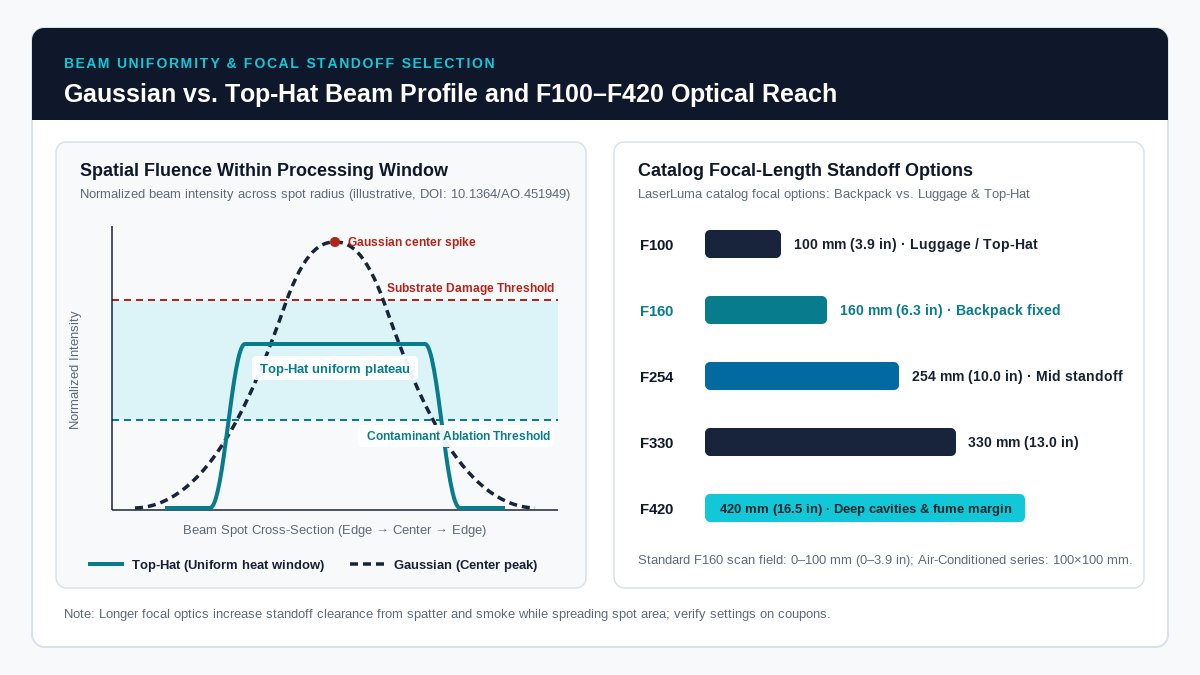
Gaussian beams spike fluence at spot center, cracking tight scale while narrowing damage margins. Top-hat (flat-top) beams distribute intensity evenly inside the ablation-to-damage window; the Applied Optics marine steel study (Tong et al., 2022) confirmed distinct surface morphology and efficiency between both beams. For textured molds, thin aluminum, and stainless welds, evaluate the 200–1,000 W top-hat pulse laser cleaning series first.
How to Choose a Pulse Laser Cleaning Machine for Metal by Focal Lens, Cooling, and Mobility
Matching a pulsed machine to shop-floor metal fabrication depends on focal lens clearance, cooling capacity, and site power or battery transport rules.
Focal Lengths (F100 to F420) and Cavity Standoff
Backpack units fix a 160 mm (6.3 in, F160) lens (0–3.9 in scan), whereas Luggage and Top-Hat models accept 100 mm (3.9 in), 160 mm, 254 mm (10.0 in), 330 mm (13.0 in), and 420 mm (16.5 in) optics. Deep pockets and heavy coating smoke call for 254–420 mm standoff to protect cover glass while confirming fluence on test metal.
Air-Cooled vs. Water-Cooled vs. Air-Conditioned Cooling
Air-cooled units (100–500 W Luggage, 200–1,000 W Top-Hat) eliminate external chillers and cold-bay freeze risks. Water-cooled vertical cabinets (500–1,000 W Top-Hat) sustain continuous high-power production. Where hot bays or wrist fatigue limit shifts, the 120–320 W air-conditioned pulse series with a 1 kg head combines refrigerated cabinet cooling with a 2.2 lb (1 kg) handpiece.
24 V Battery Backpacks (600 Wh) vs. 220 V Luggage Units
Use the 100–300 W 24 V battery backpack pulse cleaner (14±2 kg / 21±2 kg) for scaffolding or remote sites, and use the 100–500 W 220 V luggage-type pulse cleaner (5 m cable) where 220 V mains support 500 W output and five lenses. At 24 V × 25 Ah (600 Wh nominal), backpack packs exceed US 49 CFR 173.185(c)(1) small-battery exceptions (100 Wh air; 300 Wh highway/rail) and require UN 38.3 dangerous-goods compliance.
Class 4 Laser Safety, Fume Capture, and Sample Validation Before Ordering
Open-beam pulsed industrial cleaners above Class 3B limits are Class IV (Class 4) under US 21 CFR 1040.10(b)(11), posing eye and skin hazards from direct and scattered beams alongside fire and fume risks.
Federal Engineering Controls and NIOSH Fume Extraction
Per the NIOSH Hierarchy of Controls, engineering barriers outrank PPE. Verify 21 CFR 1040.10(f) controls—protective housing, interlocks, a <=130 V RMS remote interlock connector, key switch, emission indicator visible through eyewear, beam attenuator, and manual reset—plus rated optical density (OD) eyewear and local exhaust ventilation (LEV). Review our laser cleaning safety and fume extraction guide and verify SKU FDA Accession or CE documentation.
Coupon Testing and Quotation Inputs
Before purchasing, request a sample-cleaning evaluation with five inputs: substrate alloy, coating depth, required standoff (100–420 mm), power supply (24 V vs. 220 V) plus LEV, and weld, bond, or ISO 4624 inspection criteria.
FAQs
Is a 300 W or 500 W pulse laser cleaning machine better for most metal shops?
A 300 W model handles weld oxides, thin aluminum, and mobile jobs (21±2 kg Backpack, 220 V Luggage, or air-conditioned cabinets). Moving to 500 W (220 V Luggage or Top-Hat) increases removal capacity on thicker primers; verify speed on coupons.
When should you pick a MOPA pulse source over a standard Q-switched laser for cleaning?
Pick MOPA for varied coatings or heat-sensitive alloys requiring independent pulse-width (ns) and frequency (kHz) tuning, as shown by the 300 ns, 60% overlap window (99.90% PRR, Ra = 1.308 μm) on AH36 steel (2026 Materials AH36 study, PMC13707100).
How does a top-hat beam differ from a Gaussian beam on precision molds or aluminum?
Gaussian beams concentrate energy centrally, aiding stubborn localized scale while narrowing damage margins. Top-hat beams flatten energy across the spot between ablation and damage limits, protecting textured molds and aluminum.
What shipping and runtime limits apply to a 24 V 25 Ah battery backpack pulse cleaner?
A 24 V 25 Ah pack equals 600 Wh, exceeding 49 CFR 173.185(c)(1) small-battery thresholds (100 Wh air; 300 Wh highway/rail) and triggering UN 38.3 shipping rules. Confirm runtime minutes, charge time, and battery-included weight in a written quotation.
Why do focal lens options from 100 mm to 420 mm matter when choosing a pulse cleaner?
Short 100 mm and 160 mm lenses focus energy tightly (0–100 mm scan on F160), whereas 254 mm, 330 mm, and 420 mm lenses add working distance for deep cavities and smoke plumes. Validate clearance and removal on coupons.
What Class 4 safety controls and sample inputs are needed before buying?
Class IV (21 CFR 1040.10) cleaners require housing, interlocks, remote interlock connector, key switch, emission indicator, beam attenuator, manual reset, LEV capture, and OD eyewear. Submit alloy, coating thickness, standoff, power, and inspection criteria for sample trials.