Shipyard maintenance
Shipyard Laser Cleaning Pilot: The Site Evidence to Collect Before the Trial
Before a shipyard laser cleaning pilot, collect evidence on the work zone, hot-work status, coating hazards, soluble salts, containment and the recoat owner.
12 min readBy LaserLuma technical team
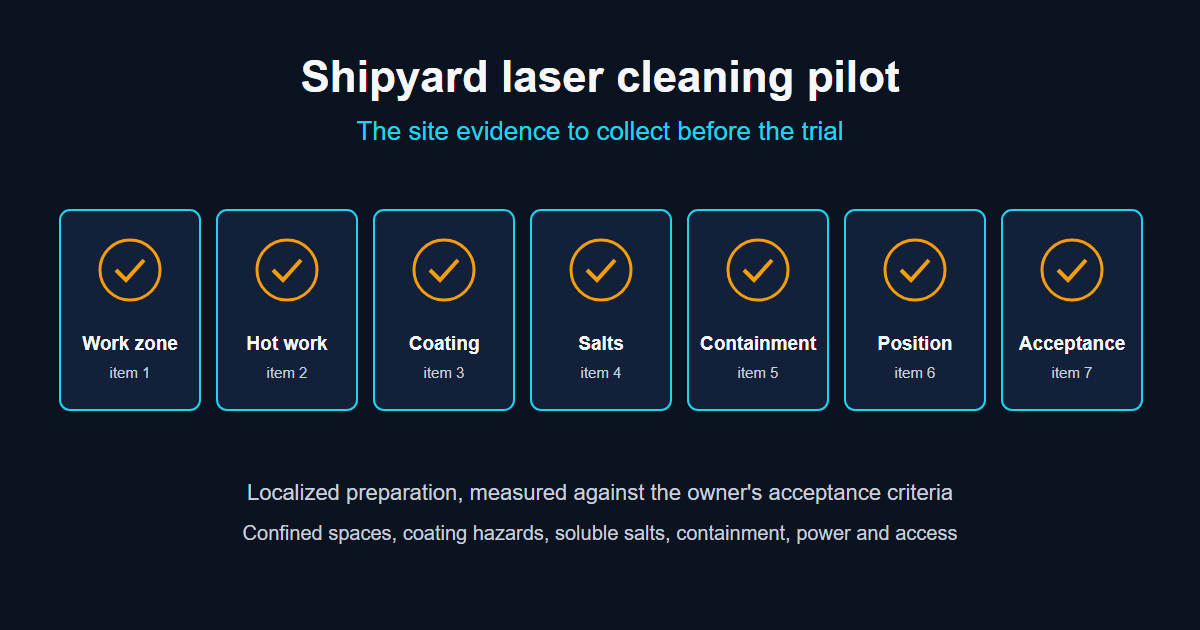
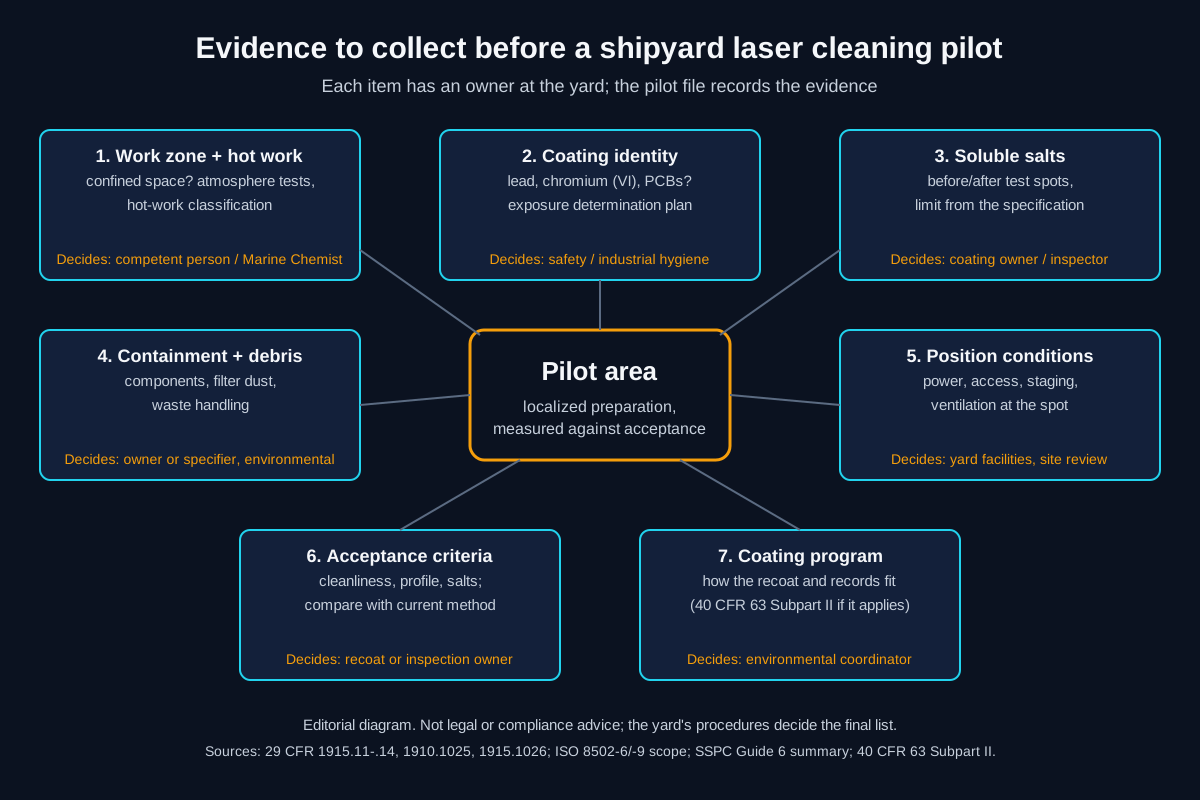
A laser cleaning pilot in a shipyard is only as useful as the evidence gathered before the first pass. Treat it as localized preparation and maintenance, not as a replacement for full-area blasting, and collect seven things first. Record the work zone and whether a competent person must test the space before anyone enters. Record how the yard's hot-work program treats laser cleaning. Identify the coating, so the exposure determination the lead standard requires can be planned. Take a soluble-salt baseline and get the salt limit from the project specification, because there is no industry-wide limit. Agree containment and debris handling with the owner or specifier. Record ventilation, power and access at the real work position. Finally, name the recoat or inspection owner and write the acceptance criteria. This guide explains each item, the rule or guide behind it, and who decides. It is general information, not legal or compliance advice.
Why a shipyard pilot needs site evidence first
Shipbuilders that test laser cleaning treat it as a trial to be measured, not a demonstration to be admired. Newport News Shipbuilding reported that it ran the first laser ablation demonstration during aircraft carrier construction aboard Enterprise (CVN 80) after receiving approval from the Navy, with tests to measure speed and job quality. It described the demonstration as a benchmark to determine whether laser ablation is more efficient than a hand grinder in that application, and said more demonstrations, time studies and safety evaluations were planned.
That framing matters because a shipyard is a hard place to run any surface preparation. OSHA's shipyard eTool lists the hazards of surface preparation as including hazardous atmospheres, fire and explosion, respiratory hazards, excessive noise, limited access, slips and trips, falls, temperature-related hazards, high-pressure hazards and electrical hazards. A laser removes the abrasive media, but it does not remove the tank, the old coating, the salt on the steel or the scaffold.
Scope the pilot the same way. LaserLuma's shipyard-maintenance page scopes the work as localized preparation and maintenance and says not to assume it replaces full-area blasting or meets a marine standard without project validation. A pilot that starts from that scope, with the evidence below already collected, can answer a narrow question well: does laser cleaning prepare this surface, in this location, to the acceptance criteria the recoat or inspection owner has written?
Evidence: Newport News Shipbuilding: first test of laser ablation · OSHA shipyard eTool: surface preparation
Map the work zone: confined spaces, adjacent spaces and hot work
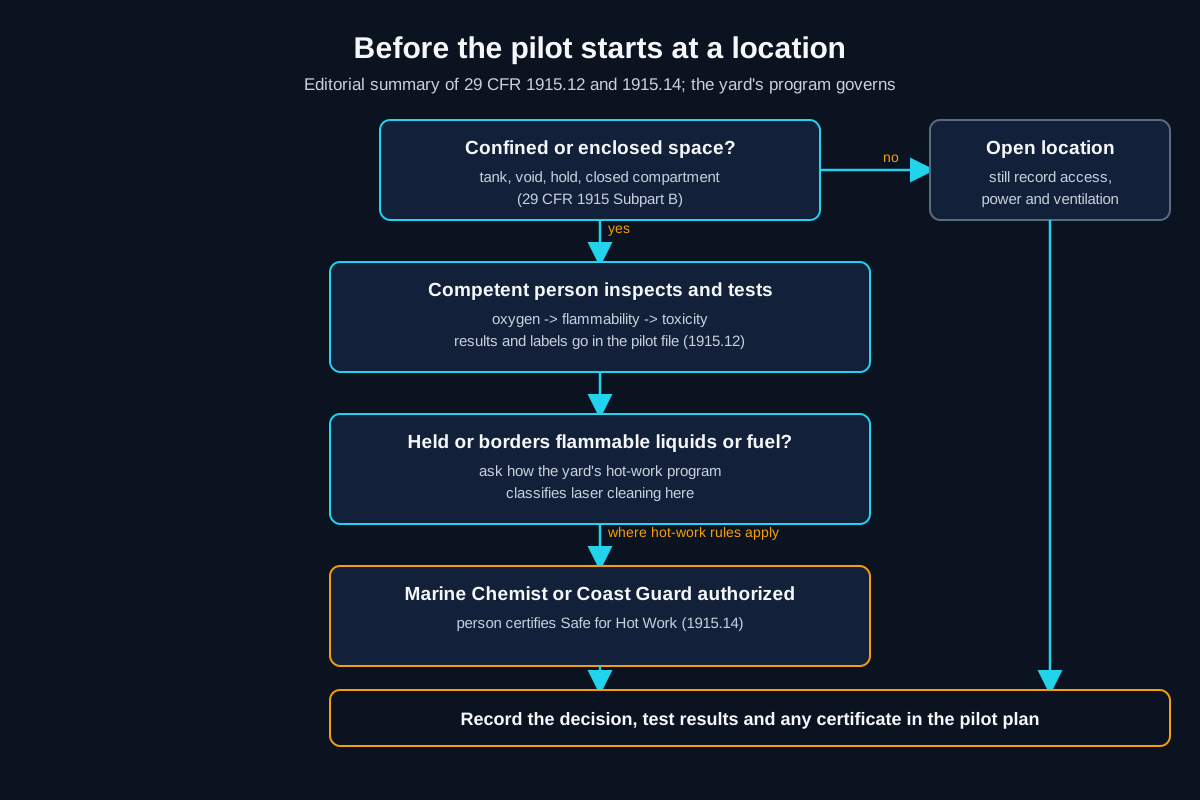
Start with where the pilot will run, because in a shipyard that decides who must sign off before anyone starts. 29 CFR 1915 Subpart B applies to work in confined and enclosed spaces and other dangerous atmospheres in shipyard employment, including vessels, vessel sections and land-side operations. A tank, a void, a double bottom or a closed compartment is a different pilot location from an open deck or a hull section on a slipway.
For enclosed locations, the testing comes first. Under 29 CFR 1915.12, atmospheric testing is performed in the order oxygen content, flammability, toxicity, and spaces such as those coated and closed up, or that contain or have contained flammable, toxic, corrosive or irritant materials, must be visually inspected and tested by a competent person before an employee enters. Put the test results and labels for each pilot location in the pilot file.
Then settle the hot-work question, which the rule text does not settle for you. 29 CFR 1915.11 defines hot work as riveting, welding, burning, the use of powder-actuated tools or similar fire-producing operations, and treats grinding, drilling, abrasive blasting or similar spark-producing operations as hot work unless they are physically isolated from any atmosphere above 10 percent of the lower explosive limit. The definition does not name laser cleaning.
The consequence of that classification can be large. Under 29 CFR 1915.14, hot work in, on or immediately next to spaces that contain or have contained combustible or flammable liquids or gases, and on fuel tanks that contain or last contained fuel, must wait until a Marine Chemist or a Coast Guard authorized person has tested the area and certified it "Safe for Hot Work". The certificate is posted near the work and kept on file for at least three months. Ask the yard's competent person or Marine Chemist how the yard's hot-work program treats laser cleaning for each pilot location, and record that decision and any certificate in the pilot plan.
Evidence: 29 CFR 1915.11 (eCFR) · 29 CFR 1915.12 (eCFR) · 29 CFR 1915.14 (eCFR)
Identify the coating before the first laser pass
The coating you remove decides the exposure controls, whatever the removal method. OSHA's shipyard eTool says surface preparation in shipbreaking involves removing hazardous materials such as paints containing polychlorinated biphenyls (PCBs) and lead. Confirm what is actually on each pilot area rather than relying on the paint schedule alone.
Two OSHA standards set the first questions. OSHA's lead standard for shipyard employment (29 CFR 1915.1025) is identical to 29 CFR 1910.1025, which applies to all occupational exposure to lead and requires each employer to determine whether any employee may be exposed at or above the action level of 30 micrograms per cubic meter of air, basing that initial determination on employee exposure monitoring. Separately, 29 CFR 1915.1026 applies to occupational exposures to chromium (VI) in shipyards and sets an action level of 2.5 micrograms per cubic meter of air.
Protective equipment follows the same logic. 29 CFR 1915.152(b) requires the employer to assess the work to determine whether hazards that call for personal protective equipment are present or likely, and to select PPE that protects against the hazards identified. A pilot is part of that work.
So before the pilot, get the coating history or sample results for each test area and plan exposure monitoring and controls from them. Treat an unidentified coating as a hazard until it is assessed. The laser settings, the extraction and the filter train all depend on what is being removed, and so does the waste stream that ends up in the filters.
Evidence: 29 CFR 1910.1025 lead (eCFR) · 29 CFR 1915.1026 chromium (VI) (eCFR) · 29 CFR 1915.152 PPE (eCFR) · OSHA shipyard eTool: surface preparation
Plan the beam, plume and filter controlsTake a soluble-salt baseline and get the limit from the owner
Marine steel carries a contaminant you cannot see. KTA-Tator explains that soluble salts such as chlorides, ferrous ions, sulfates and nitrates are deposited on steel in service or in transport, cannot be detected visually and tend to concentrate in pits and crevices. That is why a surface that looks clean after cleaning is not yet evidence that it is ready for coating.
The risk shows up later, under the new coating. KTA-Tator explains that salts trapped beneath a new coating can draw water through the film by osmosis and cause blistering, underfilm corrosion and premature coating failure. A laser pilot that ends at "looks clean" can pass the visual check and still fail the recoat.
The limit comes from the project, not from a universal number. KTA-Tator states that there is no industry-wide acceptance level for surface soluble salts and that the project specification should state the maximum surface concentration. Ask the coating owner for the limit and the test method before the pilot, not after.
The common field methods have public scope statements worth knowing. ISO 8502-6:2020 specifies a field method for extracting water-soluble contaminants with adhesive patches or sleeves on flat or curved surfaces facing any direction, and notes that the extraction may give a false negative where soluble material sits in crevices or under corrosion layers. ISO 8502-9:2020 specifies a conductometric field method for assessing water-soluble salts on steel before and/or after surface preparation, and the method cannot determine individual salts such as chlorides or sulfates.
For the pilot, test the same marked spots before and after the laser pass with the method the specification names. Whether a laser pass lowers soluble salts on that steel is something the pilot has to measure, not assume. Pitted areas deserve their own test spots, because that is where salts concentrate.
Evidence: KTA-Tator: surface soluble salt testing · ISO 8502-6:2020 (ISO catalogue) · ISO 8502-9:2020 (ISO catalogue)
Agree containment and debris handling before the pilot
"No blast media" does not mean "nothing to contain". The removed coating, rust and scale still have to be captured, handled and disposed of. Containment is a question for the pilot plan, not a feature a supplier can promise away.
The containment guide that paint-removal specifications commonly cite is written around other methods. SSPC-Guide 6-2021 covers methods of paint removal, containment systems, procedures for minimizing or preventing emissions from escaping the work area, and procedures for assessing the adequacy of those controls. According to KTA-Tator's summary, SSPC Guide 6 has tables for four removal methods (dry abrasive blast cleaning, wet methods, chemical stripping and power tool cleaning), each with classes in which Class 1 is the greatest control of emissions. It is a guide, not a standard, but it is widely specified on paint removal projects. KTA-Tator also notes that SSPC Guide 7 covers handling, testing and disposal of debris from surfaces previously painted with lead-containing paint.
State agencies publish what a containment plan should cover. Illinois EPA's lead-based paint guidance, for example, says a containment plan should provide for collecting all waste streams (liquid, abrasive, dust), consider nearby wetlands and surface water, and use impermeable groundcover over soil that removal work may affect. A dry dock, a pier or a slipway next to open water raises the same questions for a laser pilot.
Because the Guide 6 tables in that summary are organised by blasting, wet, chemical and power-tool methods, agree the containment components and the handling of debris and extractor filter dust with the owner or specifier before the pilot rather than assuming a class. Write down who collects the debris, how the used filters are bagged and labelled, and which waste program they go into.
Evidence: SSPC-Guide 6-2021 (publication index) · KTA-Tator: environmental protection using containments · Illinois EPA: lead-based paint containment
Record ventilation, power and access at the real work position
The pilot runs where the repair will run, so record the conditions there, not in the workshop. LaserLuma's shipyard-maintenance page lists work zone and access, power availability, and ventilation and containment among the site-review inputs. It recommends portable pulsed equipment for controlled or confined zones, and evaluating mobile high-power or continuous configurations only after a site review and sample test.
For each pilot position, record the power supply, the cable and hose route, the staging or access equipment and the ventilation, because limited access, falls and electrical hazards are among the surface-preparation hazards OSHA lists. In an enclosed space, the ventilation arrangement is part of what the competent person tested, so a change to it belongs in the pilot file too.
Photos help more than descriptions. A photo of the socket, the gangway, the scaffold level and the extraction hose route tells a supplier whether a portable unit can reach the work, and what a larger system would need.
Evidence: OSHA shipyard eTool: surface preparation
Choose the on-site format from the power and access you recordedName the recoat or inspection owner and the coating program
A pilot needs a judge who is not the supplier. Have the recoat or inspection owner write the acceptance criteria before the pilot, for example cleanliness, profile and salt limits from the coating specification. Then compare the laser result with the yard's current method on the same criteria, as the Newport News demonstration did for speed and job quality against a hand grinder.
The recoat of the pilot area also has an environmental program behind it at larger yards. 40 CFR 63 Subpart II applies to shipbuilding and ship repair operations at any facility that is a major source, and defines the affected source as a shipbuilding or ship repair facility with surface coating operations using at least 1,000 liters (264 gallons) of marine coating a year. The Subpart II standards in 40 CFR 63.783 limit the as-applied VOHAP content of coatings applied to ships and require VOHAP-containing materials to be handled to minimize spills and kept in closed containers free of cracks, holes and other defects.
Section 63.783 is written around the coating applied and the handling of VOHAP-containing materials, not the removal step. The recoat of a pilot area therefore runs through the yard's existing coating compliance program. Ask the environmental coordinator how the pilot's recoat and records fit it, and whether the yard is a major source at all.
Evidence: 40 CFR 63 Subpart II (eCFR) · 40 CFR 63.783 (eCFR) · Newport News Shipbuilding: first test of laser ablation
The pilot evidence pack, and what to send LaserLuma
Put the evidence in one pack before the pilot date. The table lists each item, who normally provides or decides it, and the rule or guide it comes from. It is a planning aid; the yard's own procedures decide the final list.
When the pack is ready, send it with the site review request. LaserLuma's quotation form asks for the cleaning application, the material and contaminant, the work area or part geometry, the desired next step and the country. Add the pilot locations, the coating and salt information and the acceptance criteria, and the review can scope a representative pilot and sample test.
LaserLuma's shipyard page offers a site review, and this article does not state that any LaserLuma configuration meets a shipyard, marine or environmental standard. The yard's competent person, Marine Chemist, coating owner and environmental staff keep those decisions.
| Evidence item | Who provides or decides | Rule or guide behind it |
|---|---|---|
| Pilot locations, photos, and whether each is a confined or enclosed space | Yard maintenance or project lead | 29 CFR 1915 Subpart B |
| Atmosphere test results and labels for each enclosed location | Shipyard competent person | 29 CFR 1915.12 |
| How the hot-work program treats laser cleaning; any Safe for Hot Work certificate | Competent person, Marine Chemist or Coast Guard authorized person | 29 CFR 1915.11 and 1915.14 |
| Coating history or sample results for each test area | Owner, coating supervisor, industrial hygiene | 29 CFR 1915.1025, 1915.1026 |
| Exposure monitoring plan and PPE hazard assessment | Employer's safety staff | 29 CFR 1910.1025(d), 1915.152(b) |
| Salt test method, limit and before/after test spots | Coating owner or inspector | Project specification; ISO 8502-6/-9 scope |
| Containment components, debris and filter-dust handling | Owner or specifier, environmental staff | Project specification; SSPC Guides 6 and 7 |
| Power, access, staging and ventilation at each position | Yard facilities; supplier site review | Site conditions |
| Acceptance criteria and the current-method comparison | Recoat or inspection owner | Coating specification |
| How the recoat fits the yard's coating program | Environmental coordinator | 40 CFR 63 Subpart II where it applies |
FAQs
Is laser cleaning hot work in a shipyard?
The rule text does not say. 29 CFR 1915.11 defines hot work as fire-producing operations and treats spark-producing operations as hot work unless they are isolated from flammable atmospheres, and it does not name laser cleaning. The classification belongs to the yard, and it matters: under 1915.14, hot work near spaces that held flammable liquids or fuel waits for a Safe for Hot Work certificate, so get the yard's answer in writing for each pilot location.
Do you still need containment when laser cleaning ship coatings?
Plan for it. SSPC Guide 6 covers containment of paint-removal debris, and its tables, as KTA-Tator summarizes them, are organised by blasting, wet, chemical and power-tool methods, and laser is not one of the four listed. That leaves the containment level, debris collection and extractor filter dust as decisions to settle with the owner or specifier before the pilot.
Does laser cleaning remove soluble salts before recoating?
Do not assume it does or does not. There is no industry-wide salt limit, so the project specification sets one. Test the same marked spots before and after the laser pass with the method the specification names, keeping in mind that ISO 8502-6 notes extraction can miss salts in crevices or under corrosion layers.
Can a pilot prove laser cleaning can replace blasting on a ship?
A pilot answers a narrower question: whether laser cleaning prepares a defined local area to the owner's acceptance criteria, compared with the current method. LaserLuma scopes shipyard work as localized preparation and maintenance, not a replacement for full-area blasting, and Newport News Shipbuilding framed its own demonstration as a benchmark against hand grinders.