Beam engineering
Gaussian vs Flat Top Laser Cleaning: Which Beam Profile Fits Sensitive Metals?
Compare Gaussian vs flat top laser cleaning on peak fluence (2x vs 1x), substrate hardness and adhesion trade-offs, focal sensitivity, and metal test coupons.
6 min readBy LaserLuma technical team
Published
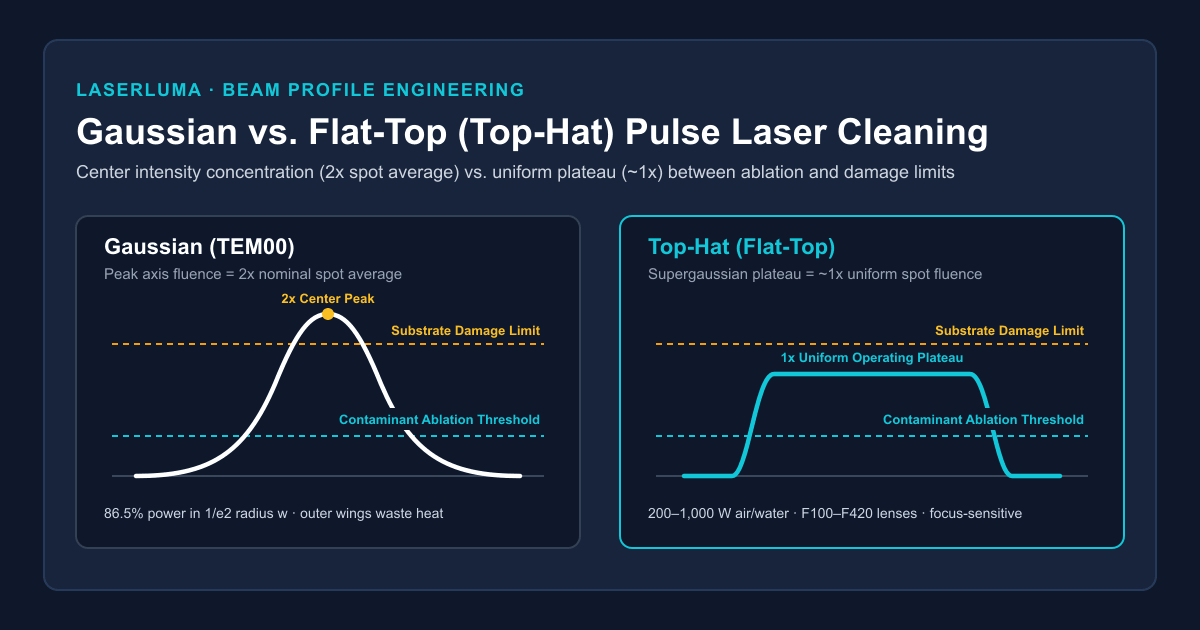
Select a flat-top (top-hat) beam when stripping coatings or thin oxides from heat-sensitive metals, precision molds, and cosmetic finishes where the ablation threshold sits close to the substrate damage limit. Choose a Gaussian beam when heavy carbon steel oxides need concentrated center intensity, structural recoating benefits from surface roughening, or coupon testing verifies lower roughness on alloys such as TC4 titanium. Compare beam shape alongside power, cooling, and safety in our pulse laser cleaning machine selection guide.
Why Are Laser Beams Gaussian and Where Does That Center Peak Cut Too Deep?
Fundamental TEM00 Cavity Physics and Power Enclosure
Stable optical resonators inside pulsed fiber lasers oscillate naturally on the fundamental transverse electromagnetic mode (TEM00, diffraction-limited beam quality factor M² = 1), and single-mode delivery fibers transmit a closely matched near-Gaussian fundamental profile whose optical irradiance declines radially from the axis along a bell-shaped curve, as documented in the RP Photonics Gaussian beams reference.
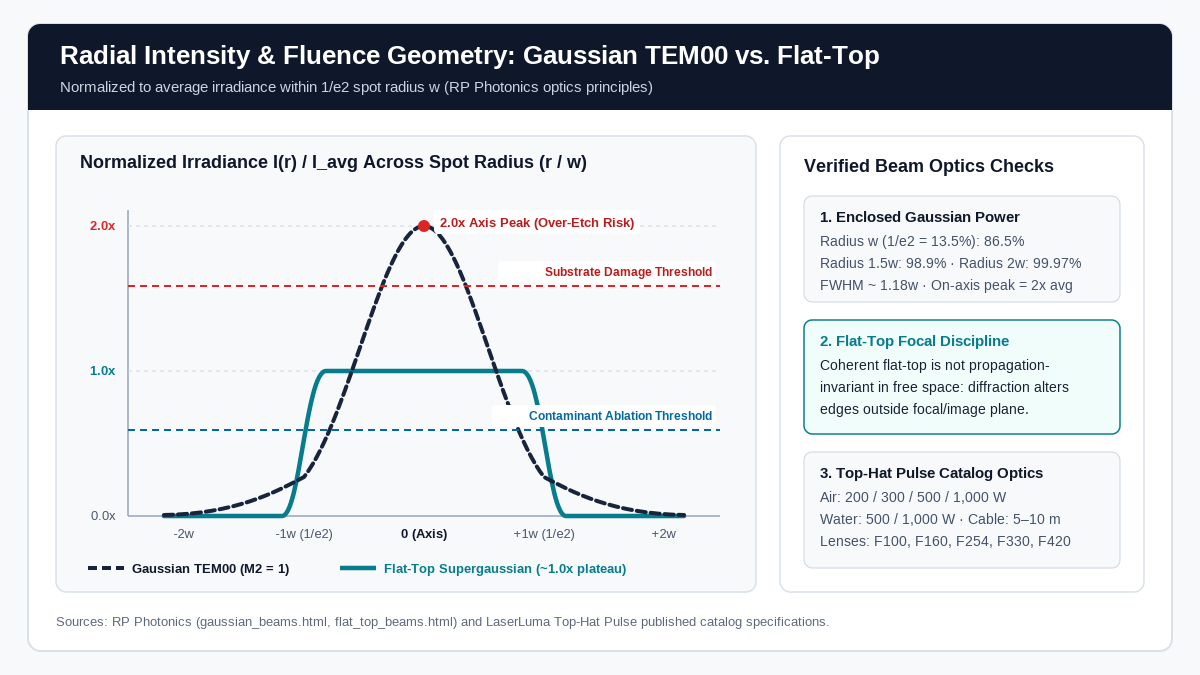
Optics engineers specify beam radius w where irradiance falls to 1/e² (13.5%) of the axial maximum. That 1/e² radius encloses 86.5% of total pulse power; widening the boundary captures 98.9% at 1.5w and 99.97% at 2w, while full width at half maximum (FWHM) measures roughly 1.18w.
The 2x On-Axis Peak Fluence Trap Inside Spot Calculations
Fluence defines pulse energy delivered per unit surface area (J/cm²). Dividing single-pulse energy by nominal 1/e² spot area (pi * w²) gives spot-average fluence, yet because peak on-axis irradiance follows 2P / (pi * w²) (carrying a factor of 1/2 in the denominator), on-axis peak irradiance and peak fluence equal 2x (2.0x) that nominal average.
Raising spot-average fluence enough for outer wings to strip coatings pushes the 2x center peak past damage limits on thin aluminum or crisp mold textures. Lowering energy until the center stays safe drops outer tails below ablation threshold, converting leftover power into conductive substrate heat. Checking the laser cleaning fluence and pulse overlap guide alongside Figure 1 separates peak risk from spot averages.
How a Top Hat Laser Beam Profile Flattens Energy and Shifts Outside Focus
Optical Homogenizers, Step-Index Fibers, and Supergaussian Order
Engineers flatten the 2x central hotspot by reshaping an input Gaussian beam with diffractive optical beam homogenizers or multimode step-index fibers, as explained in the RP Photonics flat-top beams reference. The shaped irradiance follows a higher-order supergaussian plateau near 1x uniform fluence, sharpening edge falloff as supergaussian order n rises.
This uniformity widens the usable operating margin when the energy gap between contaminant ablation and substrate overheating is narrow. As noted in the Narran beam profile comparison, higher-power cleaning platforms widely use top-hat distribution for uniform area coverage, whereas lower-power units rely on Gaussian central concentration for localized deposits.
Propagation Distortion Outside Focal Standoff and Field Lens Selection
Flat-top uniformity demands disciplined working distance. Unlike TEM00 Gaussian beams that preserve their transverse profile across propagation, a coherent flat-top beam is not a free-space propagation mode; optical diffraction distorts plateau flatness and reshapes beam edges outside the designed focal or image plane while raising M² as supergaussian order n increases.
On LaserLuma's 200–1,000 W top-hat pulse laser cleaning series, buyers pair 200 W, 300 W, 500 W, or 1,000 W air-cooled units and 500 W or 1,000 W water-cooled cabinets with F100, F160, F254, F330, or F420 field lenses (3.9–16.5 in focal standoff), delivering 0–100 mm (0–3.9 in) scan width on F160 over 5–10 m (16.4–32.8 ft) cables. Matching lens focal length to part clearance keeps the flat-top plateau locked on the target surface instead of drifting out of focus.
Gaussian vs Top Hat Laser Cleaning: Measured Metal Results and Selection Rules
Marine Steel Paint Removal vs. Titanium Oxide Surface Roughness
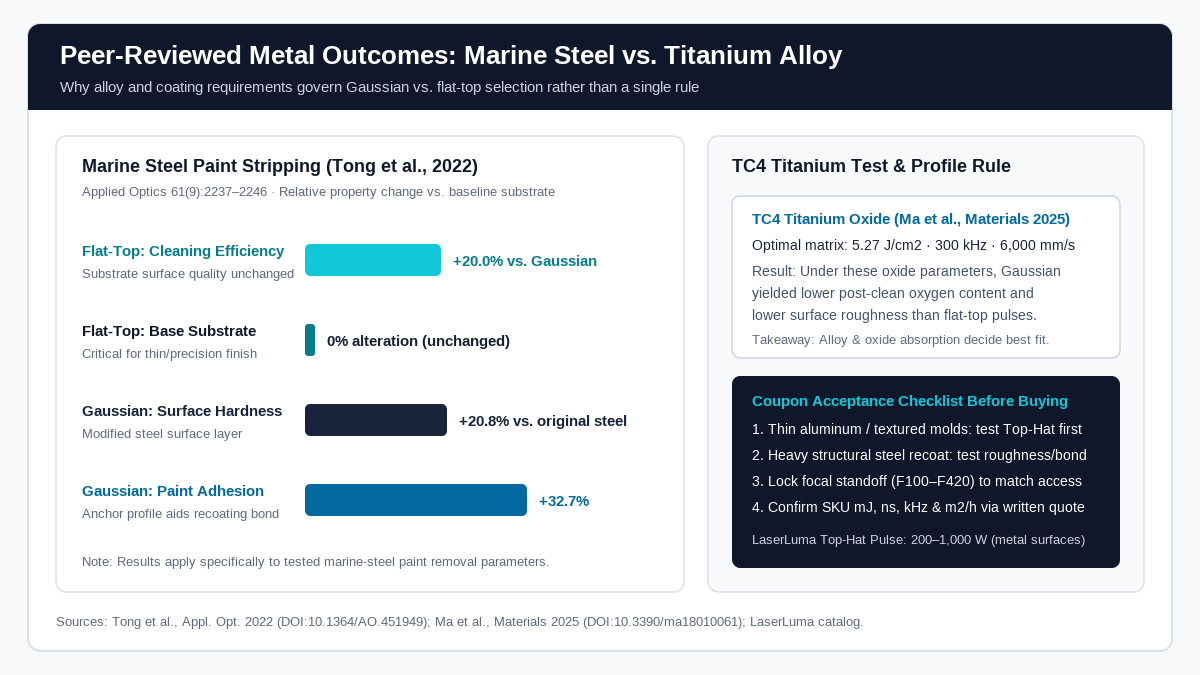
Peer-reviewed experiments confirm that neither profile wins across distinct alloys and finish criteria. In marine-steel paint removal by Tong et al. (Applied Optics 2022, Applied Optics marine steel Gaussian vs. flat-top study), the flat-top beam left steel substrate surface quality unchanged while delivering 20% higher cleaning efficiency than Gaussian pulses.
Conversely, Gaussian pulses raised marine steel surface hardness by 20.8% and increased paint adhesion by 32.7% compared with the original steel substrate. On TC4 titanium alloy oxide films, Ma et al. (Materials 2025, Materials 2025 TC4 titanium spot-pattern study) tested 5.27 J/cm², 300 kHz, and 6,000 mm/s, measuring lower post-clean oxygen content and surface roughness with Gaussian pulses than with flat-top pulses.
Alloy Selection Rules and Pre-Order Coupon Verification
Apply substrate finish tolerance, thermal sensitivity, and part standoff before selecting optics:
- Precision molds, aluminum, and zero-alteration metals: Start with a flat-top profile near 1x average fluence so center intensity stays below base-metal melting on textured mold cavities and sensitive aluminum oxide assemblies.
- Heavy structural steel awaiting primer: Evaluate Gaussian pulses when controlled surface roughening and higher surface hardness assist downstream coating bond without violating structural fatigue limits.
- Fixed-lens reach limits: Match F100–F420 standoff optics to fixture geometry so flat-top beams remain inside focus.
SKU-specific pulse energy (mJ), pulse width (ns), frequency (kHz), spot diameter, and area cleaning speed (m²/h) are confirmed by written quotation and representative trial. Submit alloy grade, coating thickness, lens standoff, and roughness or adhesion pass targets to request a sample-cleaning evaluation.
FAQs
Why are most pulsed laser cleaning beams Gaussian by default?
Stable optical cavities sustain the fundamental TEM00 mode (M² = 1), and single-mode delivery fibers carry a closely matched near-Gaussian profile placing 86.5% of pulse power inside 1/e² radius w. Producing a flat-top profile adds diffractive beam-shaping optics or multimode fiber homogenization.
How much higher is the center intensity of a Gaussian spot than a flat-top spot?
An ideal single-mode Gaussian spot concentrates on-axis peak irradiance and peak fluence at 2x (2.0x) the nominal spot average across its 1/e² area. A supergaussian flat-top beam distributes energy evenly near 1x across the central plateau.
Does a top-hat beam eliminate heat damage on all metals automatically?
No. While flat-top cleaning left marine steel unchanged in Tong et al. (2022), Ma et al. (2025) measured lower post-clean roughness and oxygen on TC4 titanium with Gaussian pulses at 5.27 J/cm², 300 kHz, and 6,000 mm/s. Excessive fluence overheats metal under either profile.
Why did Gaussian cleaning improve steel adhesion in the Applied Optics study?
Gaussian central energy modified the marine steel surface during paint removal, increasing surface hardness by 20.8% and paint adhesion by 32.7% versus the original steel substrate. The flat-top beam stripped paint 20% faster while keeping substrate quality unchanged.
Does a flat-top laser beam stay uniform if you clean outside focal standoff?
No. A coherent flat-top profile is not a propagation-invariant free-space mode, so optical diffraction alters plateau flatness and reshapes beam edges outside the focal plane. Matching F100–F420 optics to part geometry preserves uniform standoff.
What power and lens options are available in LaserLuma's Top-Hat Pulse series?
LaserLuma offers Top-Hat Pulse cleaners at 200 W, 300 W, 500 W, and 1,000 W air-cooled plus 500 W and 1,000 W water-cooled options with F100–F420 (3.9–16.5 in) lenses (0–100 mm scan on F160, 5–10 m cables). SKU mJ, ns, kHz, and m²/h ratings follow written quotation.